
Gasterophilus intestinalis
De Geer, 1776
Horse Bot Fly, Horse Botfly
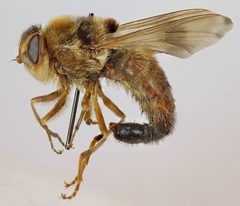
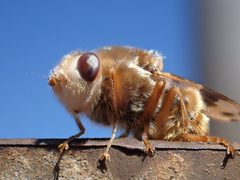
A parasitic bot fly found worldwide that infests the gastrointestinal tract of equids. are bumblebee mimics active in summer, lacking functional mouthparts and living only a few weeks. Females cement to horse hairs; larvae develop in the mouth and stomach for 8–10 months before exiting in to pupate. rarely cause clinical but adults are a nuisance to horses.
Pronunciation
How to pronounce Gasterophilus intestinalis: //ɡæsˈtɛr.əˌfaɪ.ləs ˌɪn.tɛsˈtaɪ.nə.lɪs//
These audio files are automatically generated. While they are not always 100% accurate, they are a good starting point.
Identification
Distinguished from other Gasterophilus by placement on forelimbs and shoulders (vs. intermandibular space for G. nasalis). resemble bumblebees but have a visible ovipositor and do not collect pollen. Larvae attach specifically to the non-glandular region of the stomach near the margo plicatus and in the saccus caecus, whereas G. nasalis larvae attach almost exclusively in the first ampulla of the duodenum.
Images
Habitat
Larval : gastrointestinal tract of equids, specifically the non-glandular stomach regions (saccus caecus, fundus, body, pylorus) with highest concentrations in the saccus caecus. habitat: open, elevated terrain including hilltops used for mating ; also observed resting on vegetation near horse pastures.
Distribution
Worldwide distribution. Documented in North America (Texas, California, Delaware), Europe (Belgium, Denmark, Norway, Romania), and other regions. Present year-round in stomachs of equids in southern Texas, with seasonal peaks in larval numbers during February–March and October–November.
Seasonality
active prominently in summer, with activity lasting only a few weeks. In Texas, highest average larval numbers in stomachs occur in winter and spring; smallest numbers in fall. Adult activity peaks in fall in some regions, with corresponding higher percentages of early instar larvae found in fall.
Diet
males lack functional mouthparts and do not feed. Adult females may feed on nectar but this is not confirmed. Larvae feed on tissues within the equine gastrointestinal tract.
Host Associations
- Equus caballus - definitive domestic horse, primary
- Equus asinus - definitive donkey
- Equus mulus - definitive mule
Life Cycle
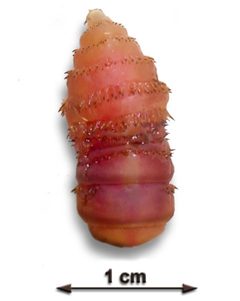
Females cement individual to hairs on the forelimbs and shoulders of equids, laying up to 1000 eggs each. Eggs hatch when licked by the during ; if not licked, first instar larvae migrate to the mouth. Larvae develop in tunnels within the tongue tissue, then second instar larvae are swallowed and attach to the non-glandular stomach wall. Larvae remain in the stomach for 8–10 months, maturing to third instar. In spring, third instar larvae pass out in and pupate in soil for 3–5 weeks before .
Behavior
males establish territorial perches on hilltops and engage in aerial combat to defend these sites; this represents a -like mating system. Females visit hilltops specifically to mate, then disperse to oviposit on . Adults exhibit "parahost "—approaching horses closely without ovipositing, potentially for mate location or environmental assessment. Adults frequently produce a buzzing sound while stationary, associated with thoracic heat production (endothermy); thoracic temperature can be elevated up to 12°C above ambient. Buzzing episodes are often terminated by attempted , with cycling periods maintaining elevated thoracic temperature.
Ecological Role
of equids; larvae occupy dorsally positioned stomach regions favoring oxygen availability. Potential minor role in pollination if females feed on nectar. Part of the gastrointestinal parasite of domestic and wild equids.
Human Relevance
Veterinary concern as a of horses, mules, and donkeys. Large may cause stomach pain or rarely obstruction at the pylorus. Controlled using macrocyclic lactones (ivermectin, moxidectin) and (metrifonate, dichlorvos); optimal treatment timing is after first hard frost when females are killed. Manual removal using bot knives is practiced; handlers must wash hands afterward as larvae can burrow into human skin (accidental myiasis). Manure management and rotational grazing reduce environmental .
Similar Taxa
- Gasterophilus nasalisAlso parasitizes equids but differs in placement (intermandibular space vs. forelimbs/shoulders) and larval attachment site (first ampulla of duodenum vs. stomach saccus caecus and non-glandular regions).
- Gasterophilus haemorrhoidalisAnother equine bot fly with distinct -laying and larval site preferences; less commonly encountered than G. intestinalis.
- Gasterophilus inermisRare with reduced mouthhook armature in larvae; distinguished by larval and less common occurrence.
Sources and further reading
- BugGuide
- Wikipedia
- GBIF taxonomy match
- iNaturalist taxon
- NCBI Taxonomy
- Catalogue of Life
- Seasonal occurrence and distribution of Gasterophilus intestinalis and Gasterophilus nasalis in the stomachs of equids in Texas
- Parahost Behavior of Adult Gasterophilus intestinalis (Diptera: Gasterophilidae) in Delaware
- Hilltop Aggregation and Mating Behavior by Gasterophilus Intestinalis (Diptera: Gasterophilidae)1
- Field observations of the host–parasite relationship associated with the common horse bot fly, Gasterophilus intestinalis
- Sound production and endothermy in the horse botfly, Gasterophilus intestinalis
- Cuticular sensilla on newly hatched larvae of Gasterophilus intestinalis and Oestrus ovis
- Seasonality, control, and risk factors for Gasterophilus intestinalis egg intensity in horses from Romania under field conditions.