
Cuterebra americana
(Fabricius, 1775)
woodrat bot fly
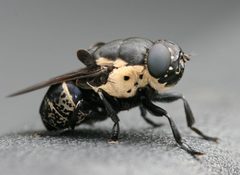
Cuterebra americana, the woodrat , is a New World skin bot fly in the Oestridae. It is a parasitic whose larvae develop subcutaneously in mammalian . The species has been documented successfully developing in atypical hosts, including the black rat (Rattus rattus) in Florida. are rarely encountered in the field and lack functional mouthparts, living only to reproduce.
Pronunciation
How to pronounce Cuterebra americana: /ˌkjuːtəˈrɛbrə əˌmɛrɪˈkeɪnə/
These audio files are automatically generated. While they are not always 100% accurate, they are a good starting point.
Images
Distribution
North America; documented in Florida, U.S.A.
Host Associations
- Neotoma spp. (woodrats) - primary typical ; inferred from and -level patterns
- Rattus rattus (black rat) - atypical documented case of successful development in Florida, representing range expansion
Life Cycle
are deposited near burrow entrances. First instar larvae hatch in response to host body heat, enter the host through natural orifices or skin breaks, and migrate to subcutaneous locations. Larvae create warbles (cyst-like structures with respiratory openings) and feed on host fluids for approximately one month, molting through three instars. Mature third instar larvae exit the host, burrow into soil, and pupate. emerge from , do not feed, and are short-lived.
Behavior
are rarely observed in nature. They are non-feeding with reduced mouthparts, focusing entirely on . are laid in rather than directly on hosts.
Ecological Role
of small mammals; -level impacts on typical appear limited based on studies of congeneric
Human Relevance
No direct medical significance; not known to parasitize humans. Documented case of switching to an introduced rodent (Rattus rattus) raises ecological monitoring considerations.
Similar Taxa
- Cuterebra fontinellaAlso a rodent bot fly, but specific to different (white-footed mice, Peromyscus leucopus)
- Cuterebra buccata / C. abdominalisRabbit and lagomorph bot flies; distinguished by red bands in and different associations
Sources and further reading
- BugGuide
- Wikipedia
- GBIF taxonomy match
- iNaturalist taxon
- NCBI Taxonomy
- Catalogue of Life
- Oestridae | Beetles In The Bush
- Newly emerged rabbit bot fly | Beetles In The Bush
- Discovery and Successful Development ofCuterebra americana(Diptera: Oestridae) from an Atypical Host,Rattus rattus(Rodentia: Muridae), in Florida, U.S.A.