
Lucilia illustris
(Meigen, 1826)
Illustrious Greenbottle Fly, green bottle fly
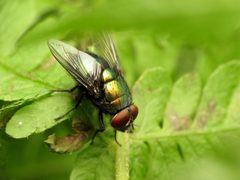
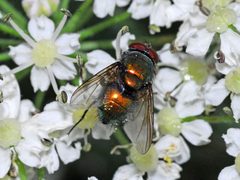
Lucilia illustris is a in the Calliphoridae, commonly known as the Illustrious Greenbottle Fly. are 6–9 mm in length with a metallic blue-green that reflects bronze and purple. The develops through three larval instars with distinct morphological characteristics at each stage. It is frequently used in due to its predictable development rate and preference for carrion in sunlit environments.
Pronunciation
How to pronounce Lucilia illustris: /luːˈsɪliə ɪˈlʌstrɪs/
These audio files are automatically generated. While they are not always 100% accurate, they are a good starting point.
Identification
Distinguished from similar Lucilia by the black bucca (cheeks) with gray pollinose, orange-tipped second antennal segment, and absence of a costal spine on the wing. The shows silvery pollen and a dark line. The metallic blue-green coloration with bronze and purple reflections differs from the more uniformly green L. sericata and the -bronze L. cuprina. First instar larvae have difficulty determining spine due to unpigmented segments; second instar shows complete spine bands on segments 2–9 with -lateral spines only on segment 8; third instar has complete spine bands on segments 2–10 with five to six irregular rows on segment 11 and a smooth dorsal surface on segment 12. are large and darkly pigmented with six to eight relatively large branches on anterior spiracles.
Images
Appearance
are 6–9 mm in length. The is metallic blue-green with bronze and purple reflections; silvery pollen may appear on the surface with a dark longitudinal line. The bucca (cheeks) are black with gray pollinose and black hairs. : first segment black, second orange-tipped, third segment dark brown or black and approximately three times the length of the second. The is dark with long dark cilia. The back of the is black with three to four rows of black cilia behind the . Legs are black; wings are translucent without a costal spine. The matches the thorax in coloration but may appear slightly white in certain lights; the first segment has metallic and dark brown coloring, the second segment shows a slight central spot indication on the margin, and the third and fourth segments bear long upright bristles with the fourth also having scattered hairs and a marginal row of bristles.
Habitat
Associated with carrion in sunlit or bright areas. visit flowering plants. Larval development occurs on decomposing animal matter, with a documented preference for cooler conditions compared to other .
Distribution
Recorded from Belgium, Denmark, Norway, and Sweden. The has been documented in experimental studies involving from South and Southeast Asia (India region), suggesting broader distribution in the Palaearctic region.
Seasonality
Active during cooler periods; at ambient temperatures around 7.7°C, L. illustris typically constitutes the largest maggot on carcasses. lifespan approximately three weeks.
Diet
feed on flowers. Females require carrion protein for maturation. Larvae are carrion feeders; in experimental conditions, larvae fed first on brain tissue of living vertebrates before other soft tissues.
Host Associations
- Carrion - breeding substratePrimary oviposition site; females lay approximately 200 per batch, up to 10 batches per lifetime
- Open wounds - occasional oviposition siteSecondary site for deposition
- Excrement - occasional oviposition siteRarely used for laying
- Clarias batrachus - experimental Larvae entered body and killed ; fed on brain first
- Bufo melanostictus - experimental Larvae entered body and killed
- Rana tigrina - experimental Larvae entered body and killed
- Hemidactylus fluviviridis - experimental Larvae entered body and killed
- Columba livia - experimental Larvae entered body and killed ; warm-blooded host showed shortest larval development period
- Suncus murinus - experimental Larvae entered body and killed ; warm-blooded host showed shortest larval development period
- Sheep - facultative myiasis agentImplicated in myiasis in northerly Palaearctic regions; primarily feeds on necrotic tissue
- Pheasants - Larvae mechanically Clostridium botulinum from infected carrion to live birds
Life Cycle
hatch in approximately 24 hours at 25°C. Larvae pass through three instars, molting between each. First instar: segments 2–9 with full spine sets as borders, segment 8 with lighter spines, segment 9 with nearly colorless reduced spines, segment 10 with several light rows, segment 11 with two to three dark rows posteriorly, segment 12 with . Second instar: segments 2–9 with complete anterior spine bands, segment 8 with -lateral spines only, segments 9–12 with spine bands, cephaloskeleton with cornua of consistent width. Third instar: complete spine bands on segments 2–10, segment 11 with five to six irregular rows, segment 12 smooth dorsally, large dark posterior . Larvae pupate underground after third instar. averages 10 days under ideal conditions. Development from egg to third instar can occur in as few as 14 days from time of death. Larval development is shorter on living tissue than on dead animals, shortest on living warm-blooded .
Behavior
are rapidly attracted to carrion. Mating occurs near oviposition sites. Females aggregate in masses around -laying locations. Temperature strongly influences development rate. Larvae show tissue feeding preference for brain tissue in experimental conditions. Third instar larvae disperse from carrion to pupate underground. The exhibits facultative myiasis , primarily targeting necrotic tissue on living .
Ecological Role
Decomposer of animal remains. Facultative capable of causing myiasis in necrotic tissue. Mechanical of Clostridium botulinum in avian . Competitor with other on carrion, with temporal separation based on temperature preferences.
Human Relevance
Primary forensic for estimating time and place of death due to predictable development and preference for sunlit carrion. Used in maggot debridement therapy because it causes myiasis only in necrotic tissue, making it safer than that attack healthy tissue. Potential economic impact through sheep myiasis in northern Palaearctic regions and through vectoring avian botulism in pheasant production. First described by Johann Wilhelm Meigen in 1826; specific epithet means 'brilliant' in Latin.
Similar Taxa
- Lucilia sericataCommon green bottle fly; more uniformly green without bronze-purple reflections; has costal spine; second antennal segment not orange-tipped; bucca not black with gray pollinose
- Lucilia cuprinaAustralian sheep ; -bronze coloration; introduced worldwide; causes primary myiasis in living sheep rather than facultative myiasis in necrotic tissue
- Phormia reginaBlack blow fly; black or deep metallic blue-black coloration; spring and fall activity period; delays oviposition compared to immediate -laying by Lucilia
- Chrysomya rufifaciesHairy maggot blow fly; predatory on other maggot ; summer activity; introduced Australian native in southern United States
More Details
Forensic Development Data
Development rate has been thoroughly researched for forensic applications, with -to- timing accurate within hours based on temperature and climate conditions. identification is critical as different species have different development rates.
Experimental Parasitism Findings
A 1969 experimental study demonstrated that larvae hatched from carcass-derived could parasitize and kill living vertebrates including fish, amphibians, reptiles, birds, and mammals, feeding first on brain tissue. Development was fastest on warm-blooded . Natural occurrence of this in wild has not been confirmed.
Medical Applications
Maggot debridement therapy uses larvae to clean non-healing wounds through three actions: debridement of necrotic tissue, disinfection by killing bacteria, and stimulation of wound healing. L. illustris is suitable due to its restriction to necrotic tissue.
Sources and further reading
- BugGuide
- Wikipedia
- GBIF taxonomy match
- iNaturalist taxon
- NCBI Taxonomy
- Catalogue of Life
- Bohart Museum Features UC Davis Forensic Entomologist Bob Kimsey | Bug Squad
- Learning About the Importance of Blow Flies Through Maggot Art | Bug Squad
- How Blow Flies Compete (or Not) for Decomposition Duties
- Entomological Medicine: Working to Bring Maggot Therapy Into Wider Use
- Bug Eric: Zebra Jumper
- Bug Eric: What's on Dat Scat?
- Studies on the behaviour of Lucilia illustris Meigen as a parasite of vertebrates under experimental conditions