
Calobatina geometra
(Robineau-Desvoidy, 1830)
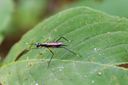
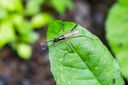
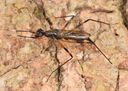
Calobatina geometra is a of stilt-legged fly in the Micropezidae, occurring in the eastern United States. are noted for their distinctive elongated middle and hind legs, their -like appearance suggesting mimicry of ichneumonid wasps, and their characteristic of waving their forelegs, which bear conspicuous white bands above black feet. The species has been observed aggregating on standing dead oak trunks in dry-mesic upland deciduous forest.
Pronunciation
How to pronounce Calobatina geometra: //ˌkæloʊˈbætiːnə dʒiːˈɒmɛtrə//
These audio files are automatically generated. While they are not always 100% accurate, they are a good starting point.
Identification
The combination of greatly elongated middle and hind legs, -like body form, and white-banded forelegs with black feet distinguishes this from other flies. The waving of the forelegs is also distinctive. Similar Micropezidae species in Missouri lack this specific pattern of white foreleg bands and associated behavior. The ichneumonid wasp-like appearance may cause initial confusion with actual wasps, but the short and single pair of wings ( present) confirm dipteran identity.
Images
Appearance
are relatively large flies with extremely elongated, stilt-like middle and hind legs that give the its . The forelegs are shorter but conspicuously marked with white bands above black feet. The overall body form and coloration suggest mimicry of parasitic in the family Ichneumonidae. Like all Diptera, are short and reduced.
Habitat
Dry-mesic upland deciduous forest, particularly areas with standing dead oak trees (Quercus alba). The has been observed aggregating on dead white oak trunks, suggesting a possible association with decaying wood or the microhabitat conditions such trees provide.
Distribution
Eastern North America; specifically recorded from Missouri in dry-mesic upland deciduous forest . The broader range likely encompasses the eastern and central United States, though precise distribution details are limited.
Seasonality
have been observed in late summer (August) in Missouri. The full seasonal activity period is not well documented.
Behavior
are known to aggregate on standing dead tree trunks, with observations of multiple individuals congregating on dead white oak. A distinctive involves waving the forelegs in front of the body, which has been hypothesized to serve either as intraspecific communication or as a deceptive signal to /competitors. The white bands on the forelegs may function as visual signals during this behavior. The forelegs may also serve an sensory function analogous to given the reduced antennae typical of Diptera.
Similar Taxa
- Other Calobatina species in MissouriSeveral other Calobatina occur in Missouri, but they lack the distinctive white-banded forelegs with black feet and the associated waving observed in C. geometra.
- Ichneumonid wasps (Ichneumonidae)The -like appearance may cause superficial confusion, but ichneumonids have long, multi-segmented , two pairs of wings, and lack the extremely elongated stilt-legs characteristic of Micropezidae.
More Details
Mimicry hypothesis
The strong resemblance to ichneumonid wasps suggests possible Batesian or Müllerian mimicry, though whether this is purposeful (evolved) or happenstance is unclear. The adaptive significance of the foreleg waving and white leg bands remains unresolved, with hypotheses including intraspecific communication, deception, or sensory .
Knowledge gaps
Relatively little is known about the of this , including larval and feeding habits, complete seasonal activity period, and the functional significance of its distinctive morphological and behavioral traits. The on dead oak trunks has been documented but not explained.