
Micropeza corrigiolata
(Linnaeus, 1767)
stilt-legged fly
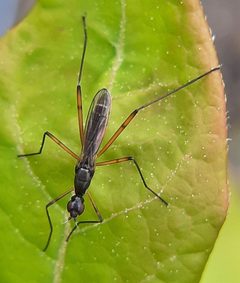
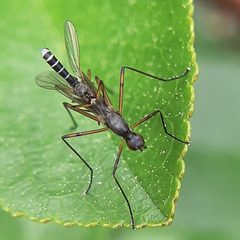
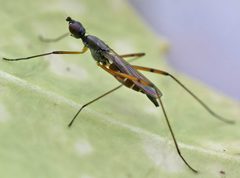
Micropeza corrigiolata is a small stilt-legged fly in the Micropezidae, characterized by its elongated legs and slender black body with yellow abdominal markings. The is widespread across Europe, the Near East, and has been introduced to the . are active during summer months and are predatory on small insects, while larvae develop as root feeders on leguminous plants.
Pronunciation
How to pronounce Micropeza corrigiolata: /ˌmaɪk.roʊˈpɛzə kɔˌrɪdʒ.iˈoʊ.lɑːtə/
These audio files are automatically generated. While they are not always 100% accurate, they are a good starting point.
Identification
Distinguished from other Micropezidae by the combination of: deep black body with yellow-edged abdominal tergites (not solid black); reddish ; clear unmarked wings; and specific leg proportions relative to body length. Similar in Micropeza may lack the distinct yellow tergite margins or show different eye coloration.
Images
Appearance
Small, slender fly measuring 4–7 mm in length. Body deep black with long, slender bearing narrow yellow edges on tergites. bullet-shaped with reddish . Legs stilt-like, elongated and slender. black. Wings clear and membranous. Tibiae with short bristles.
Habitat
Open, sunny including meadows, agricultural fields, bushy areas, and sparse vegetation. Strongly associated with leguminous plants. Also found along margins of sandy beaches. Requires vegetation structure that supports hunting and larval root-feeding development.
Distribution
Native to Europe and the Near East; introduced and established in the . Recorded from Belgium, Denmark, Norway, and throughout most of Europe.
Seasonality
active from early June to early August. Peak activity during mid-summer months.
Diet
: predatory, feeding on small insects. Larvae: root-feeding, known to feed on roots of Pisum arvense (field pea), Trifolium pratense (red clover), and Medicago sativa (alfalfa).
Host Associations
- Pisum arvense - larval food plantlarvae feed on roots
- Trifolium pratense - larval food plantlarvae feed on roots
- Medicago sativa - larval food plantlarvae feed on roots
Life Cycle
Complete . Larval stage spent in soil feeding on plant roots, particularly of leguminous . in early summer, with period lasting approximately two months. Specific pupal stage details not documented.
Behavior
are active , hunting small insects in open vegetation. The elongated stilt-like legs are adapted for on vegetation surfaces and capturing prey. activity concentrated during mid-summer.
Ecological Role
function as of small insects, potentially contributing to pest suppression in agricultural . Larvae are root herbivores, primarily on leguminous crops and wild plants, with possible minor impacts on plant health in dense .
Human Relevance
Minor agricultural relevance due to larval root-feeding on cultivated legumes (pea, clover, alfalfa), though not considered a major pest. may provide incidental of small insect pests in crop fields and meadows.
Similar Taxa
- Other Micropeza speciesMay share general stilt-legged ; distinguished by M. corrigiolata's specific combination of yellow-edged abdominal tergites, reddish , and clear wings
- Other Micropezidae genera members share elongated legs but differ in body proportions, wing patterns, and leg-to-body ratios; M. corrigiolata has characteristic bullet-shaped and specific color pattern
More Details
Taxonomic history
Originally described as Musca corrigiolata by Linnaeus in 1767, later transferred to Micropeza.
Morphological adaptations
The stilt-like leg is characteristic of the Micropezidae and represents an for foraging on vegetation surfaces and capturing small aerial or plant-dwelling prey.