
Calobatinae
Genus Guides
2- Cnodacophora
- Compsobata(stilt-legged flies)
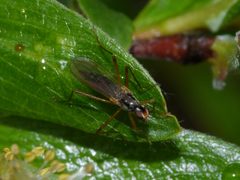
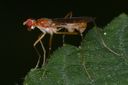
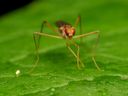
Calobatinae is a of stilt-legged flies ( Micropezidae) in the order Diptera. Members are characterized by their elongated legs and slender bodies, adaptations associated with their distinctive locomotion and microhabitat preferences. The subfamily contains such as Calobata and Compsobata, with distributed across various regions. Calobatines are generally associated with decaying organic matter and moist where their larvae develop.
Pronunciation
How to pronounce Calobatinae: /ˌkeɪloʊˈbætɪnaɪ/
These audio files are automatically generated. While they are not always 100% accurate, they are a good starting point.
Identification
Distinguished from other Micropezidae by the combination of: extremely elongated legs with tibiae and often longer than the ; reduced wing venation with characteristic weak or absent anal ; and the presence of a distinct prosternal structure. Calobatinae lack the pronounced modifications seen in some other micropezid groups. Larvae are dorsoventrally flattened with reduced head capsules and respiratory , differing from the more cylindrical larvae of related subfamilies.
Images
Appearance
possess extremely long, slender legs relative to body size, with the mid and hind legs often elongated for stilt-like . Body is typically slender and somewhat flattened. Wings are usually clear or lightly patterned. are short with a terminal . The overall gestalt is of a delicate, long-legged fly capable of distinctive rocking or stilting locomotion.
Habitat
frequent moist, shaded environments near larval development sites. Larval include decaying vegetable matter, compost, fermenting fruit, and other decomposing organic substrates. Often associated with forest floors, riparian zones, and anthropogenic accumulations of organic debris.
Distribution
Widespread in temperate and tropical regions. Documented from North America, Europe, Asia, and parts of the Neotropics. Specific range varies by ; Calobata occurs primarily in the Palearctic and Nearctic, while Compsobata has a broader distribution including the Oriental region.
Seasonality
activity peaks during warmer months in temperate zones, with some exhibiting extended periods from late spring through autumn. Tropical species may be active year-round.
Diet
: little direct observation; likely feed on nectar, honeydew, or surface moisture films. Larvae: saprophagous, consuming decaying plant matter and associated microorganisms.
Life Cycle
Complete . deposited in or near decaying organic substrate. Larvae pass through three instars, feeding within decomposing matter. occurs within the larval substrate or in adjacent soil. Developmental duration varies with temperature and substrate quality.
Behavior
exhibit characteristic stilt-legged , moving with deliberate, rocking motions while foraging or perching. Capable of rapid when disturbed. Males engage in leg-waving displays during courtship. Larvae are sluggish, remaining within substrate.
Ecological Role
Larvae contribute to decomposition of plant matter, accelerating nutrient cycling in terrestrial . may serve as minor or prey for larger arthropods and small vertebrates.
Human Relevance
Generally benign; occasionally encountered in composting operations or where organic waste accumulates. No known economic damage or transmission. Some have been used in contexts due to predictable of decomposing remains.
Similar Taxa
- MicropezinaeAnother of Micropezidae; distinguished by less extreme leg elongation, more robust body proportions, and different wing venation patterns including a more developed anal .
- TaeniapterinaeMicropezid with generally shorter legs and often striking wing patterns; frequently wave wings rather than legs during display .
- NeriidaeSeparate of stilt-legged flies with convergent leg elongation; distinguished by different wing venation, shape, and absence of the prosternal characteristics of Calobatinae.
More Details
Taxonomic History
Calobatinae has undergone periodic revision; some authors have treated constituent as members of separate or elevated to rank. Current consensus places Calobata, Compsobata, and related genera within this subfamily based on larval and skeletal characters.
Larval Morphology
Calobatine larvae are diagnostic for the : strongly flattened body, reduced and retracted capsule, and on short respiratory tubes. These traits distinguish them from the more cylindrical, phytophagous or predatory larvae of other micropezid groups.