
Micropezinae
Genus Guides
1- Micropeza(stilt-legged flies)
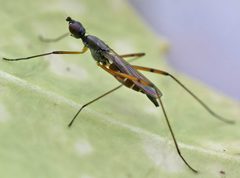
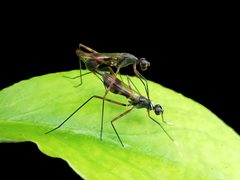
Micropezinae is a of stilt-legged flies within the Micropezidae, characterized by exceptionally long, slender legs adapted for on vegetation. Members are recognized by their distinctive posture, with front legs raised and waving during movement. The subfamily contains the majority of described within Micropezidae and is distributed primarily in tropical and subtropical regions worldwide. are often found in humid forest near streams or decaying vegetation.
Pronunciation
How to pronounce Micropezinae: /ˌmaɪkroʊˈpɛzɪni/
These audio files are automatically generated. While they are not always 100% accurate, they are a good starting point.
Identification
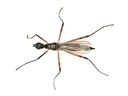
Distinguished from other Micropezidae (Calycopteryginae, Taeniapterinae) by the combination of: front widely separated; forelegs and midlegs greatly elongated, usually at least twice the body length; tibiae and of forelegs and midlegs slender and unmodified (not expanded or flattened); wing with reduced anal lobe and weak anal . Taeniapterinae have shorter, stouter legs and more robust body. Calycopteryginae possess modified hind wings or reduced wing venation not seen in Micropezinae.
Images
Habitat
Humid tropical and subtropical forests, particularly near streams, seeps, and areas of decaying organic matter. Often found on low vegetation, leaf litter, or rotting logs in shaded microhabitats. Some occur in disturbed including agricultural areas and gardens.
Distribution
Pantropical and subtropical distribution, with highest diversity in the Neotropics. Present in Central and South America, Africa, Madagascar, Southeast Asia, and Australia. Records from temperate regions are limited and often represent vagrant or introduced .
Seasonality
activity generally coincides with wet seasons in tropical regions; year-round presence in equatorial zones. Specific poorly documented for most .
Behavior
walk with a distinctive slow, deliberate gait, often waving the elongated forelegs in front of the body—possibly a sensory or defensive function. When disturbed, individuals may freeze or drop to the substrate. is weak and rarely sustained, typically consisting of short hops between vegetation. Males have been observed using forelegs in , though detailed behavioral studies are limited.
Ecological Role
likely function as scavengers or of small in decaying organic matter . Larval poorly known; presumed to develop in moist decaying vegetation or organic substrates. Specific roles in nutrient cycling or remain undocumented.
Human Relevance
No direct economic importance. Occasionally encountered by entomologists and naturalists in tropical fieldwork. Some have been used in phylogenetic studies of Diptera .
Similar Taxa
- TaeniapterinaeAlso within Micropezidae but distinguished by shorter, stouter legs, more robust body, and different wing venation; occupies similar but exhibits more active, hopping .
- Neriidae (cactus flies)Superficially similar elongated-legged flies, but have unmodified front , different wing venation with distinct anal , and are primarily associated with cactus or rotting cactus tissue rather than forest floor .
More Details
Taxonomic history
Micropezinae has historically served as the primary grouping for most stilt-legged flies, with other erected more recently based on phylogenetic analyses. The subfamily is not monophyletic in some molecular studies, suggesting future revision may be needed.
Morphological convergence
The extreme leg elongation in Micropezinae represents with unrelated long-legged flies in such as Dolichopodidae and Tanyderidae, though leg proportions and body plan remain distinctive.