
Atherigona reversura
Villeneuve, 1936
Bermudagrass Stem Maggot, shoot-fly
Atherigona reversura is a muscid shoot fly commonly known as the bermudagrass stem maggot. Native to Central and Southeast Asia, it has become an agricultural pest in the Americas, causing significant damage to bermudagrass and stargrass forage systems. The was first detected in Hawaii, then spread to the continental United States beginning in 2009, and has since been reported in South America including Argentina and Uruguay. Larval feeding in grass stems causes death of upper leaves, stunted growth, and reduced forage yields.
Pronunciation
How to pronounce Atherigona reversura: //ˌæθɛrɪˈɡoʊnə ˌriːvərˈsjʊərə//
These audio files are automatically generated. While they are not always 100% accurate, they are a good starting point.
Identification
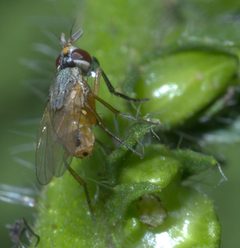
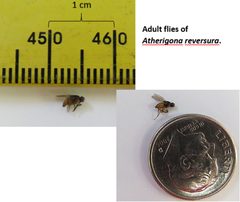
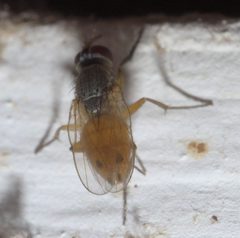
distinguished by small size, yellow-gray coloration, and angular . Larval damage is diagnostic: upper two to three leaves die while lower plant remains green, resembling frost damage. Cutting open stem below dead leaves reveals tunneling and possibly the maggot. Fields with fine-stemmed bermudagrass cultivars (Coastal, Alicia, Russell, common) show higher rates than coarse-stemmed varieties. Distinguished from other Atherigona by association with Cynodon and geographic distribution.
Images
Habitat
Agricultural and rural areas cultivating bermudagrass or stargrass for forage, hay, or turf. Thrives in improved pastures and hayfields with dense, vigorous grass growth. Not typically a pest in grazed pastures due to livestock consumption of and larvae.
Distribution
Native to Central and Southeast Asia. Introduced to Hawaii (date unclear), continental United States (California 2009, Georgia 2010, Texas 2013, now southeastern US), Mexico, Argentina (2014–2015), and Uruguay. Within the US, increase from south to north seasonally.
Seasonality
build gradually from south to north. Active mid-June in Central Florida, late July in North Georgia. Multiple per year with completing in approximately 2–3 weeks. lifespan 21–28 days.
Diet
Larvae feed on tender tissues of new grass shoots, specifically at the node where the stem emerges. limited to bermudagrass (Cynodon dactylon) and stargrass (Cynodon nlemfuensis). do not feed on plant material.
Host Associations
- Cynodon dactylon - primary Bermudagrass; forage grass with economic value for livestock
- Cynodon nlemfuensis - primary Stargrass
Life Cycle
laid on underside of leaves. Larvae emerge after approximately 2.5 days, move to stem node, and feed internally causing leaf death. Feeding damage visible after 1–3 days. Larvae exit stem, drop to ground, and pupate in soil for 7–10 days before . Total development from egg to adult approximately 2–3 weeks. Several per year.
Behavior
females oviposit on leaf undersides. Larvae are internal feeders, tunneling in grass stems at nodes. Larvae leave stems to pupate in soil. Adults are strong fliers and disperse to new fields. Not problematic in grazed pastures because livestock consume and larvae with grass, preventing buildup.
Ecological Role
Agricultural pest causing significant yield loss in grazing and hay production systems. Feeding halts shoot elongation, stunts growth, and delays dry matter accumulation. Repeated attack on regrowth shoots compounds damage. No known beneficial ecological functions.
Human Relevance
Major economic pest of bermudagrass forage systems. Damage results in reduced hay yields and quality, with fields appearing frost-damaged. Management involves harvesting to break and applying 7–10 days after cutting to protect regrowth. Research ongoing on , , and to improve management.
Similar Taxa
- Other Atherigona species contains ~300 ; A. reversura distinguished by specificity to Cynodon and geographic range
- Fall armyworm (Spodoptera frugiperda)Also damages bermudagrass but is a caterpillar with chewing mouthparts, not internal stem feeder; causes complete defoliation rather than selective upper leaf death
More Details
Cultivar Susceptibility
All bermudagrass cultivars are susceptible, but those with high shoot numbers, small shoot diameter, and narrow leaves show higher fly preference. Tifton 85 and other coarse-stemmed varieties experience less frequent though still potentially significant damage, especially late season.
Management Research Needs
Effective sampling methods for or larvae are unknown. for application have not been established. Current recommendations based on damage observation rather than predictive monitoring.
Sources and further reading
- BugGuide
- Wikipedia
- GBIF taxonomy match
- iNaturalist taxon
- NCBI Taxonomy
- Catalogue of Life
- Hay and Pasture Insects - AgriLife Extension Entomology
- First report of Atherigona reversura Villeneuve, 1936 (Diptera, Muscidae) in Uruguay
- First reports of the invasive pest Bermudagrass Stem Maggot, Atherigona reversura Villeneuve, 1936 (Diptera: Muscidae), in South America