
Fannia fuscula
(Fallén, 1825)
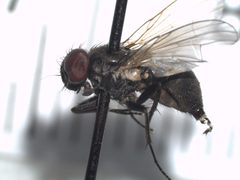
Fannia fuscula is a of lesser house fly in the Fanniidae. It is a small, grayish fly distributed across northern Europe and parts of North America. The species belongs to a commonly associated with decaying organic matter and environments. Like other Fannia species, it is often found in and around human structures.
Pronunciation
How to pronounce Fannia fuscula: //ˈfæn.i.ə ˈfʌs.kjʊ.lə//
These audio files are automatically generated. While they are not always 100% accurate, they are a good starting point.
Identification
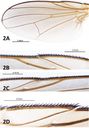
Distinguished from similar Fannia by the specific pattern of thoracic stripes and abdominal markings. Fannia fuscula has narrower dark stripes on the compared to Fannia canicularis. The male terminalia require microscopic examination for definitive identification. Separation from Fannia scalaris is based on differences in the fore and wing angles.
Images
Appearance
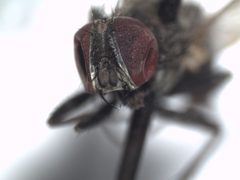
Small to medium-sized fly, typically 4–6 mm in length. Body grayish with three dark longitudinal stripes on the . Wing venation characteristic of Fanniidae, with a distinct bend in the fourth longitudinal . checkered with light and dark markings. short with .
Habitat
Associated with decaying organic matter, including compost, manure, and decomposing plant material. Often found in barns, stables, and other agricultural buildings. In natural settings, occurs in woodland edge with abundant leaf litter decomposition.
Distribution
Northern Europe including Denmark, Norway, and Sweden. Also recorded from Vermont, United States. The appears to have a transatlantic distribution with in both Palearctic and Nearctic regions.
Seasonality
activity recorded from late spring through autumn in northern European localities. Peak abundance typically occurs during summer months.
Behavior
are known to enter buildings and exhibit characteristic hovering patterns typical of the Fannia. Larval development occurs in decaying organic substrates.
Ecological Role
Decomposer; larvae break down decaying organic matter, contributing to nutrient cycling. may serve as prey for spiders and other .
Human Relevance
Considered a nuisance pest when occurring in high numbers in agricultural and residential buildings. Not known to transmit , but presence indicates unsanitary conditions or decaying organic material nearby.
Similar Taxa
- Fannia canicularisLarger with broader thoracic stripes; more common in domestic settings
- Fannia scalarisSimilar size but differs in fore structure and wing venation angles; requires microscopic examination to separate