
Pegomya hyoscyami
(Meigen & Panzer, 1809)
beet leafminer, spinach leafminer
Pegomya hyoscyami is a small grey fly in the Anthomyiidae, commonly known as the beet leafminer or spinach leafminer. The is economically significant as a pest of leafy greens, with larvae that mine between leaf surfaces causing substantial damage to crops. Multiple occur annually, with activity beginning in spring. The species belongs to a complex of four closely related species that were historically confused.
Pronunciation
How to pronounce Pegomya hyoscyami: //pəˈɡoʊmiə haɪəksiˈæmaɪ//
These audio files are automatically generated. While they are not always 100% accurate, they are a good starting point.
Identification
are distinguished from by morphological features of the male and female genitalia; precise identification requires examination of these structures. The is one of four in the P. hyoscyami complex (along with P. betae, P. cunicularia, and P. exilis) that were historically confused; these species differ in adult of both sexes. Larvae create blotch mines in leaves of Chenopodiaceae, distinguishing them from leafminers of other plant .
Images
Habitat
Agricultural and horticultural environments where plants (beet, spinach, chard, and related greens) are cultivated. Found in fields, gardens, and other settings with suitable host vegetation.
Distribution
Europe; also recorded from North America (conterminous United States) and Japan. Distribution records confirmed from Denmark, Norway, and Sweden.
Seasonality
emerge in April–May. Multiple occur annually, with continuous activity through the growing season.
Diet
Larvae feed internally on leaf tissue of plants, mining between upper and lower leaf surfaces. do not feed on leaf tissue; feeding habits of adults are not documented.
Host Associations
- Beta vulgaris - beet
- Spinacia oleracea - spinach
- Beta vulgaris subsp. cicla - chard
Life Cycle
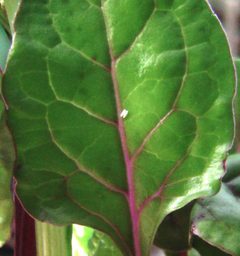
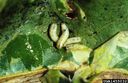
are laid on undersides of leaves and hatch in 4–6 days. Larvae burrow into leaves, initially creating thin trails that expand into blotches or "blisters." Larval development takes 7–16 days. Mature larvae drop to the ground to pupate in soil, though some may pupate within the leaf. Larvae may move between leaves before . emerge in 2–4 weeks. Two to five eggs are laid per oviposition event.
Behavior
Larvae are leaf miners, feeding internally between leaf surfaces. Larvae may move from leaf to leaf before entering soil to pupate. Some larvae pupate within leaves rather than in soil. are active in spring and repeat the reproductive cycle, producing several per year.
Ecological Role
Herbivore and agricultural pest. and natural enemy relationships are not documented in available sources.
Human Relevance
Significant agricultural pest of leafy greens. Damage from larval mining reduces crop quality and yield. Control relies on cultural methods: floating to exclude , prompt removal and destruction of infested leaves, and yellow sticky traps for adult monitoring. are ineffective because larvae are protected inside leaves.
Similar Taxa
- Pegomya betaeMember of the P. hyoscyami ; distinguished by genital . Both occur in North America.
- Pegomya cuniculariaMember of the P. hyoscyami ; distinguished by genital . Occurs in Europe and Japan.
- Pegomya exilisMember of the P. hyoscyami ; distinguished by genital . Occurs in Europe and Japan.