
Eutrichota lipsia
(Walker, 1849)
root maggot fly
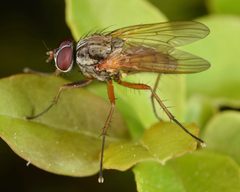
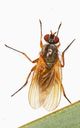
Eutrichota lipsia is a of root-maggot flies in the Anthomyiidae. It is a small, inconspicuous dipteran with a documented presence in North America, including observations in the Kansas City region during citizen science events. The species is associated with moist and has been observed near mud puddles.
Pronunciation
How to pronounce Eutrichota lipsia: /juːˈtrɪk.oʊ.tə ˈlɪp.si.ə/
These audio files are automatically generated. While they are not always 100% accurate, they are a good starting point.
Identification
As a member of Anthomyiidae, Eutrichota lipsia can be distinguished from similar small flies by its reduced wing venation with a weak or absent anal , and a generally dull grayish coloration. Separation from other Eutrichota and related anthomyiid requires examination of male genitalia and chaetotaxy (bristle arrangement).
Images
Habitat
Has been observed in urban park settings with mixed oak-hickory forest and open glades. Observations include proximity to mud puddles and moist ground surfaces, suggesting association with damp soil conditions.
Distribution
Documented in North America, with confirmed observations in Leavenworth County, Kansas, USA. GBIF records indicate broader North American distribution.
Seasonality
have been observed in late April to early May in the Kansas City region, indicating spring activity.
Human Relevance
Observed during citizen science events (City Nature Challenge), contributing to biodiversity documentation. No documented economic or medical significance.
Similar Taxa
- Eutrichota sp.Other congeneric require detailed morphological examination for separation; -level identification is more readily achievable in field conditions.
- Delia spp.Related anthomyiid root-maggot flies with similar and appearance; distinguished by subtle differences in wing venation and bristle patterns.
More Details
Taxonomic History
Originally described as Anthomyia lipsia by Walker in 1849, later transferred to Eutrichota.