
Anthomyia illocata
Walker, 1856
Root Maggot Fly
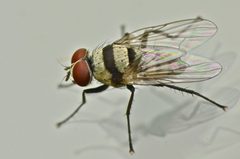
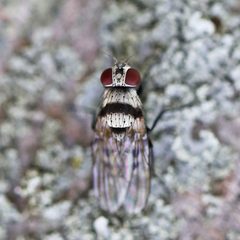
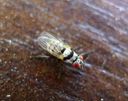
Anthomyia illocata is a small fly in the Anthomyiidae, commonly known as the Root Maggot Fly. The was first described by Walker in 1856 and has since been documented across multiple continents including South America, Hawaii, and China. Its complete mitochondrial was sequenced in 2022, revealing a 16,236 genome with 13 protein-coding genes and an A+T content of 78.7%. The species belongs to a family of approximately 2,000 described species worldwide.
Pronunciation
How to pronounce Anthomyia illocata: /ænˈθoʊmiə ɪˈloʊkætə/
These audio files are automatically generated. While they are not always 100% accurate, they are a good starting point.
Images
Habitat
Moist, cold forests. Associated with and carrion.
Distribution
Panzhihua, Sichuan, China (26°36′46"N, 101°35′21"E); Paraná, Brazil; Hawaii, United States. The Anthomyiidae has approximately 2,000 described worldwide.
Diet
Larvae are . feed on fermented vegetation or animal urine and .
Behavior
have been observed as active and may act as potential for spread.
Ecological Role
Active ; potential .
More Details
Mitochondrial Genome
First complete mitochondrial (16,236 ) sequenced using Illumina NovaSeq 6000. Contains 13 protein-coding genes, two rRNA genes, 22 tRNA genes, and a non-coding control region. A+T content is 78.7%. Phylogenetic analysis indicates Anthomyiidae is with Pegomya sister to Scathophagidae.
Specimen Origin
The sequenced specimen was collected from Panzhihua, Sichuan, China.