
Ornithomya
Latreille, 1802
bird louse flies
Species Guides
1Ornithomya is a of louse flies ( Hippoboscidae) comprising approximately 31 of obligate avian . All species are blood-feeding of birds, primarily Passeriformes. are dorsoventrally flattened with reduced or absent wings in many individuals. The genus exhibits adenotrophic viviparity, with larvae developing entirely within the female and deposited as fully mature third instars that immediately pupate. Species show varying degrees of specificity correlated with bird nesting .
Pronunciation
How to pronounce Ornithomya: /ɔːrˈnɪθəˌmaɪə/
These audio files are automatically generated. While they are not always 100% accurate, they are a good starting point.
Identification
identification relies on wing microtrichia patterns (when wings present), combined and length, wing length, number and arrangement of setae on scutellum and , and ratios of costal sections between radial vein junctions. Molecular markers (COX1, species-specific primers) are increasingly used to distinguish cryptic species and confirm status. Ornithomya species are distinguished from other hippoboscid by their association with birds (vs. mammals in Lipoptena and Neolipoptena), presence of wings in most (vs. wingless Crataerina), and specific wing venation and setal patterns. O. fringillina exhibits intraspecific morphological variation in wing microtrichia previously misinterpreted as distinct species.
Images
Appearance
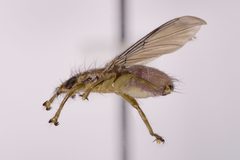
are dorsoventrally flattened, laterally compressed bodies adapted for movement through avian plumage. Body size varies by , generally 3–6 mm in length. is small, retractable into thoracic grooves. are well-developed; ocelli present or reduced depending on species. are short, three-segmented, fitting into grooves on head. Wings, when present, bear characteristic patterns of alar microtrichia used in species identification; wings frequently shed after location. Legs are stout, ending in strong claws for gripping feathers. Body coloration ranges from yellowish-brown to dark brown or black. is flexible and expandable during blood feeding.
Habitat
Strictly associated with avian and their nesting environments. specificity varies by : some associate with hole-nesting birds (e.g., Parus, Sitta), others with open-nesting passerines (e.g., Turdus, Fringilla), ground-nesters, or colonial cliff-nesters (e.g., swallows, house martins). Urban occur on pigeons and other birds. Microhabitat is the plumage and nest material of host birds; flies leave hosts primarily to deposit larvae or seek new hosts.
Distribution
distribution excluding Antarctica. Highest in Southeast Asia and Africa. Present across the Palearctic, Nearctic, Neotropical, Afrotropical, Oriental, and Australasian regions. Individual distributions correlate with bird ranges and nest-site availability. European fauna includes at least 4–5 species with documented range expansions (e.g., O. comosa expanding in Central Europe).
Seasonality
Activity correlated with bird breeding seasons and nest availability. present year-round on permanent hosts but peak abundance during nesting periods when new hosts are available and larval deposition sites (nests) are abundant. Pupal may extend the in temperate regions. Specific varies by and host association.
Diet
Obligate ; both sexes feed exclusively on avian blood. feed repeatedly on birds. No free-living feeding stage.
Host Associations
- Passeriformes (perching birds) - primary Primary order; includes diverse with varying nesting ecologies
- Paridae (tits, chickadees) - Hole-nesting for specific Ornithomya
- Sittidae (nuthatches) - Hole-nesting
- Turdidae (thrushes) - Open-nesting
- Fringillidae (finches) - Open-nesting ; type host for O. fringillina
- Hirundinidae (swallows, martins) - Colonial cavity or mud-nest ; preferred hosts for several including O. delichoni
- Columba livia (rock dove/feral pigeon) - for O. avicularia and O. avicularia aobatonis in urban environments
- Corvidae (crows, rooks, jays) - for O. avicularia; Eurasian rook (Corvus frugilegus) documented host
Life Cycle
Adenotrophic viviparity: hatch within the female's reproductive tract; three larval instars develop entirely in utero, nourished by secretions from female accessory glands. Fully developed third instar larva is deposited singly at intervals; larva immediately pupates upon deposition in nest material. Pupal period lasts several weeks to months depending on temperature. emerge from , seek host birds, and may retain wings temporarily before shedding after host location. No free-living larval feeding stage.
Behavior
Strong jumping ability facilitates transfer. are permanent , leaving hosts only to deposit larvae or locate new hosts. Host-seeking peaks during bird breeding seasons. Newly emerged adults may retain functional wings for ; wings frequently shed after host acquisition, particularly in established . Dorsoventral flattening and lateral compression enable rapid movement through plumage against feather grain. Host specificity varies: some are polyxenic (multiple host species), others show narrow preference correlated with nest type.
Ecological Role
Obligate of birds; linked to breeding success and nest availability. Potential role in transmission among birds and, through host-switching, to mammals. Serves as phoretic host for feather mites (e.g., Promyialges pari). Part of nest-associated in bird nesting microhabitats.
Human Relevance
Occasional nuisance when bird nest near human habitation. Documented potential of avian including spp., spp., and Trypanosoma corvi; molecular screening has detected these agents in field-collected specimens. Host-switching to humans documented, raising concerns for zoonotic pathogen bridge potential. Used as model organisms for studying -host , cryptic identification, and molecular of .
Similar Taxa
- LipoptenaMammalian louse flies; distinguished by association (mammals vs. birds) and subtle morphological differences in structure and genitalia
- NeolipoptenaMammalian ; distinguished by association and reduced wing structures
- CrataerinaAvian louse flies but are wingless; Ornithomya typically retain wings (at least temporarily) and show different preferences (swifts vs. passerines)
- StenepteryxHippoboscid with distinct wing venation and associations; separated by specific setal and wing microtrichia patterns
More Details
Taxonomic complexity
The exhibits morphological variation that has led to taxonomic confusion. O. fringillina includes multiple wing microtrichia patterns previously described as distinct ; molecular data confirm these as intraspecific . O. bequaerti and O. candida may represent additional morphotypes of O. fringillina rather than valid species. Ongoing research suggests cryptic diversity may be resolved through integrated morphological and molecular approaches.
Molecular ecology tools
-specific markers have been developed for O. avicularia, O. biloba, and O. chloropus to enable rapid identification without reliance on wing characters. COX1 sequencing provides additional resolution for phylogeographic and genetic studies.
Species diversity
count has increased from 29 to approximately 31 with recent descriptions including O. delichoni (2024) from Russian Far East and O. palmae from Canary Islands. Updated identification keys cover 32 species incorporating morphological and association data.
Sources and further reading
- BugGuide
- Wikipedia
- GBIF taxonomy match
- iNaturalist taxon
- NCBI Taxonomy
- Catalogue of Life
- Mites Associated With British Species of Ornithomya (Diptera: Hippoboscidae)
- THE LIFE HISTORY OF THE BRITISH SPECIES OF ORNITHOMYA (DIPTERA: HIPPOBOSCIDAE)
- Ecology of the bird hippoboscid, Ornithomya avicularia aobatonis, observed in Minami Park, Fukuoka City
- New host record for Ornithomya variegata (Diptera: Hippoboscidae) in New Zealand with a review of previous records in Australasia
- Development of a novel molecular tool to study molecular ecology of Ornithomya (Hippoboscidae) avian louse flies
- An aspect in the life history of Ornithomya avicularia aobatonis Matsumura (Diptera: Hippoboscidae) observed at Minami Park, Fukuoka, Kyushu, Japan
- THE FIRST RECORD OF PROMYIALGES PARI FAIN, 1965 (ACARIFORMES: EPIDERMOPTIDAE) FROM THE LOUSE FLY ORNITHOMYA AVICULARIA L., 1758 (DIPTERA: HIPPOBOSCIDAE) IN EUROPEAN RUSSIA
- Description of a new Ornithomya Latreille, 1802 (Diptera: Hippoboscidae) species with a key to all species of this genus
- Clarifying the Taxonomy of the Finch Louse Fly Ornithomya Fringillina (Curtis) (Diptera: Hippoboscidae) – An Analysis of Morphotypes
- Host-related genetic differentiation of a polyxenic avian ectoparasite, Ornithomya avicularia (Hippoboscidae)
- Updated taxonomic keys for European Hippoboscidae (Diptera), and expansion in Central Europe of the bird louse fly Ornithomya comosa (Austen, 1930) with the first record from Slovakia
- Bird Louse Flies Ornithomya spp. (Diptera: Hippoboscidae) as Potential Vectors of Mammalian Babesia and Other Pathogens
- Design of species-specific molecular markers for PCR-based differentiation of bird louse flies Ornithomya avicularia, Ornithomya biloba and Ornithomya chloropus (Diptera: Hippoboscidae).
- Ornithomya palmae species nova (Diptera: Hippoboscidae) a new species of louse fly from the Canary Islands.