
Amiota
Loew, 1862
Species Guides
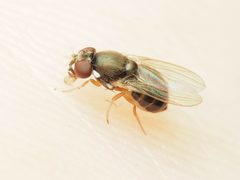
2Amiota is a of small flies in the Drosophilidae, established by Loew in 1862. The genus contains over 100 described with a distribution, though it exhibits particularly high diversity in East Asia. Southwestern China has been hypothesized as a possible center of origin and diversification. Some species serve as intermediate and for , including Amiota okadai which transmits the zoonotic Thelazia callipaeda.
Pronunciation
How to pronounce Amiota: /ˌæmɪˈoʊtə/
These audio files are automatically generated. While they are not always 100% accurate, they are a good starting point.
Identification
Amiota are distinguished from other drosophilid primarily by male genitalia , particularly features of the and surstyli. Species-level identification relies on detailed examination of genitalic structures including the shape and armature of the hypandrium, aedeagus, and epandrial lobes. The genus is placed in Steganinae, tribe Gitonini, and can be separated from related genera by combinations of characters including wing venation and chaetotaxy, though specific diagnostic features vary among species groups.
Images
Habitat
occupy diverse environments across their range. In East Asia, they occur in montane forest systems including the Qinling mountain system, where the range serves as a biogeographic barrier with species distributed across Oriental and Palearctic regions. Amiota okadai has been documented in wildlife home range areas including national nature reserves, with monitoring conducted using fly-trap methods.
Distribution
distribution with records from Europe (Denmark, Norway, Sweden), Asia (China, Japan, and other East and Southeast Asian countries), and other regions. In China, documented from the Qinling mountain system, southwestern China, Hengduan Mountains, and multiple national nature reserves including Foping, Tangjiahe, Wolong, and Fengtongzhai. Biogeographic analysis recognizes three realms: Southeast Asia, south China, and the east Palearctic.
Seasonality
Amiota okadai monitoring in China conducted from April to November, suggesting extended activity period during warmer months. Specific seasonal patterns for most undocumented.
Host Associations
- Thelazia callipaeda - intermediate and Amiota okadai transmits this zoonotic ; infected flies documented in wildlife home range areas
- wild giant pandas - accidental of transmitted by Amiota okadaiinfected with Thelazia callipaeda in Foping National Nature Reserve
- wild boars - accidental of transmitted by Amiota okadaiinfected with Thelazia callipaeda in wildlife home range
- leopard cats - accidental of transmitted by Amiota okadaiinfected with Thelazia callipaeda in wildlife home range
- black bears - accidental of transmitted by Amiota okadaiinfected with Thelazia callipaeda in wildlife home range
- domestic dogs and cats - for Thelazia callipaedaprimary threatening human near wildlife areas
- humans - definitive for Thelazia callipaedaend for transmitted by Amiota okadai
Behavior
Amiota okadai has been observed to increase sharply in specific years (2019 in Foping National Nature Reserve), though general behavioral patterns for the remain poorly documented.
Ecological Role
Amiota okadai functions as a for zoonotic transmission, connecting wildlife cycles to domestic animal and human in surrounding villages. The contributes to parasite transmission cycles in wildlife home range areas, potentially increasing risk for human populations near reserves.
Human Relevance
Amiota okadai is of medical and veterinary significance as the intermediate and for Thelazia callipaeda, a causing thelaziosis in humans and animals. China reports the highest number of human thelaziosis cases globally. The detection of infected wildlife including giant pandas indicates expanded transmission risk for human near wildlife reserves.
Similar Taxa
- Other Steganinae generaAmiota shares Steganinae with multiple ; distinguished by male genitalia and tribal placement in Gitonini
- GitonaRelated in tribe Gitonini; separated by genitalic and chaetotaxy characters
More Details
Phylogenetic relationships
Molecular phylogenetic studies using COI and ND2 mitochondrial genes have identified the Amiota alboguttata group as , with the monophyletic Amiota basdeni group nested within it. These two groups represent the largest species groups in the .
Species discovery
Numerous have been described in recent decades, particularly from China, with many new species described by Chen and collaborators. The shows high with over 100 described species.
Biogeographic significance
The Qinling mountain system serves as an important biogeographic barrier for Amiota, with distributions spanning the Oriental-Palearctic boundary. Faunal comparisons reveal distinct biogeographic realms in East and Southeast Asia.
Sources and further reading
- BugGuide
- Wikipedia
- GBIF taxonomy match
- iNaturalist taxon
- NCBI Taxonomy
- Catalogue of Life
- Molecular phylogeny and species delimitation of Amiota alboguttata and Amiota basdeni species groups (Diptera: Drosophilidae) from East Asia
- Genus Amiota Loew (Diptera: Drosophilidae) from the Qinling mountain system, central China
- First Report of Thelazia Callipaeda Infection in Amiota Okadai and Wildlife in Wildlife Home Range, China