
Drosophila hydei
Sturtevant, 1921
Hydei Fruit Fly
Drosophila hydei is a in the Drosophilidae, notable for possessing the largest recorded sperm of any Drosophila at approximately 23 mm—over ten times the male body length. It is a member of the hydei species subgroup within the repleta species group. The species is widely used as a feeder insect in the pet trade and has contributed significantly to genetics research through the Minos , which has been developed into a versatile genetic tool for gene disruption across diverse .
Pronunciation
How to pronounce Drosophila hydei: /dɹoʊˈsɒfɪlə ˈhaɪdi/
These audio files are automatically generated. While they are not always 100% accurate, they are a good starting point.
Identification
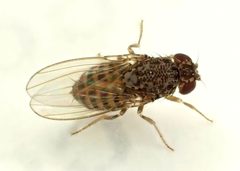
Distinguished from similar Drosophila by its notably larger body size and the distinctive variegated pigment pattern on the . Most reliably separated from D. melanogaster by size; D. hydei is substantially larger. The specific epithet honors Dr. R. R. Hyde, who first recognized the species as distinct from D. repleta.
Images
Appearance
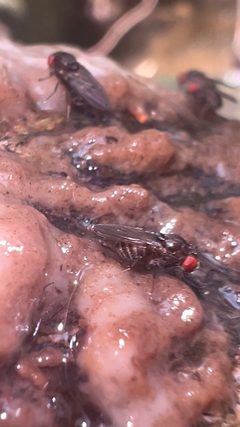
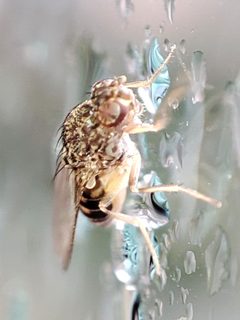
Large-bodied with variegated pigment pattern on the . Larger than the common laboratory fruit fly Drosophila melanogaster, to which it bears superficial resemblance despite 50 million years of divergence. Flightless varieties have been developed for the pet trade.
Habitat
Commonly associated with compost piles worldwide. Found in decaying organic matter and fermenting substrates.
Distribution
distribution with records from multiple continents including North America, South America (Brazil), Europe (Belgium), and oceanic islands (Galápagos, São Miguel). Present in both native and introduced ranges.
Diet
Feeds on decaying organic matter and microbial associated with fermentation, typical of vinegar flies in the Drosophilidae .
Life Cycle
Complete with , larval, pupal, and stages. Specific developmental timing not documented in available sources.
Behavior
Has been observed to serve as a for phoretic mites, including Macrocheles muscaedomesticae, which attach to the fly's body. Wild can harbor Spiroplasma bacteria that provide defense against .
Ecological Role
Decomposer in compost and decaying organic matter . Serves as for bacterial endosymbionts (Spiroplasma) and phoretic mites. Acts as prey for in natural .
Human Relevance
Widely used as a feeder insect in the pet trade, with flightless varieties commercially available. Significant contribution to genetic research through the Minos , which has been utilized in the Drosophila Gene Disruption Project and applied to gene function studies across numerous and . Occasionally used in film production as a stand-in for other insects.
Similar Taxa
- Drosophila melanogasterSuperficially similar in appearance but separated by approximately 50 million years of evolution; D. hydei is notably larger with distinct thoracic pigmentation
- Drosophila repletaHistorically confused with D. hydei; distinguished by Dr. R. R. Hyde's work establishing D. hydei as a distinct
More Details
Sperm biology
Possesses the largest recorded sperm in the Drosophila at over 20 mm, with metabolic and genetic correlates linking sperm length to female mating frequency. The genes blanks and heph are implicated in regulating this process.
Genetic tools
The Minos , originally identified as a repetitive element in the D. hydei , has been developed into a transgenic tool used to disrupt genes in diverse genomes and has facilitated disruption of over 10,000 genes in D. melanogaster as part of the Drosophila Gene Disruption Project.
Sources and further reading
- BugGuide
- Wikipedia
- GBIF taxonomy match
- iNaturalist taxon
- NCBI Taxonomy
- Catalogue of Life
- Christine Tabuloc's Seminar: Inside Her Intricate Research World of Drosophila | Bug Squad
- Hollywood is for the Bugs
- Parasite Evolution: Why One Entomologist Studies Mites That Hitchhike on Flies
- How an Evolutionary Biologist Found Her Place in Entomology
- African Fig Fly Meets Spotted-Wing Drosophila in the U.S.
- Dry, Red Sticky Trap Improves Spotted-Wing Drosophila Monitoring
- Lampbrush loop-specific protein of Drosophila hydei.