
Drosophila busckii
Coquillett, 1901
Busck's fruit fly
Drosophila busckii is a fruit fly that has evolved a unique ecological specialization among drosophilids: to and behavioral preference for dimethyldisulfide (DMDS), a neurotoxic sulfur volatile emitted by rotting vegetables and mushrooms. Native to North America, it has spread globally and is strongly associated with human environments as a commensal. The species uses DMDS as a key olfactory cue for locating food and oviposition sites, allowing it to exploit substrates toxic to competing drosophilid species. Its resistance mechanism likely involves insensitivity of the c oxidase (COX) complex, the typical target of DMDS in other insects.
Pronunciation
How to pronounce Drosophila busckii: //droˈso.fɪ.lə ˈbus.ki.aɪ//
These audio files are automatically generated. While they are not always 100% accurate, they are a good starting point.
Identification
Distinguished from similar drosophilid by the combination of dark thoracic stripes (including the trident-shaped marking) and completely transparent, unmarked wings. The species' strong attraction to dimethyldisulfide (DMDS) and association with rotting vegetables, particularly potatoes, provides additional ecological diagnostic characters. Unlike Drosophila suzukii, it lacks a serrated ovipositor and does not attack intact fruit.
Images
Appearance
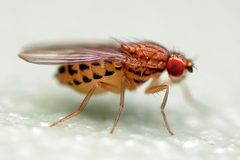
Small drosophilid fruit fly with transparent, unmarked wings. bears dark stripes, including a distinctive trident-shaped pattern on the .
Habitat
Strongly associated with rotting vegetables including potatoes, chicory, mushrooms, cauliflower, Brussels sprouts, and spinach. Occupies human-modified environments as a commensal . Successfully completes its on substrates emitting dimethyldisulfide (DMDS) and dimethyltrisulfide (DMTS), toxic sulfur volatiles that exclude competing drosophilid species.
Distribution
Native to North America; now with established in Asia, Europe, Oceania, and South America. Member of the cosmopolitan guild of Drosophila associated with human environments. Possible origin in southeast Asia suggested but not confirmed.
Diet
Feeds on rotting vegetable matter and mushrooms, specifically substrates emitting dimethyldisulfide (DMDS) and dimethyltrisulfide (DMTS). Laboratory reared on Wheeler-Clayton food medium.
Host Associations
- Aspergillus niger - associated withFungal association on rotting substrates
- Erwinia carotovora - associated withBacterial soft rot on vegetables
Life Cycle
Completes full on DMDS-emitting substrates including rotting vegetables and mushrooms. Development occurs on decaying plant matter that produces toxic sulfur volatiles.
Behavior
Exhibits strong oviposition preference for substrates emitting dimethyldisulfide (DMDS), using this compound as a precise olfactory cue to locate food and -laying sites. Demonstrates positive to DMDS at concentrations toxic to other drosophilid , enabling separation from competitors. Acoustic stimuli mediate sexual . Shows response behavior with documented genetic variability in natural .
Ecological Role
Occupies a unique exploiting toxic sulfur-emitting decaying matter with substantially reduced competition from other drosophilids. May play a role in soft rot transmission through associations with pathogenic microbes including Aspergillus niger and Erwinia carotovora. Serves as a potential model organism for studying resistance to toxic gases affecting mitochondrial function.
Human Relevance
Human commensal strongly associated with agricultural and food storage environments, particularly where potatoes and other vegetables decay. Laboratory model for studying evolutionary adaptations to toxic compounds and mechanisms of mitochondrial toxin resistance. Not a direct crop pest as it does not attack intact fruit.
Similar Taxa
- Drosophila suzukiiBoth are drosophilid associated with fruit, but D. suzukii possesses a serrated ovipositor for attacking intact soft fruit and lacks the DMDS specialization of D. busckii
- Drosophila melanogasterWidely used model drosophilid that lacks to DMDS and does not show the same specific attraction to sulfur volatiles; occupies different
- Zaprionus indianusAnother drosophilid with striped thoracic pattern, but distinguished by paired silver and black stripes on and , four respiratory filaments on , and different associations
More Details
DMDS resistance mechanism
Resistance to dimethyldisulfide neurotoxicity likely involves insensitivity of the c oxidase (COX) complex, which is the typical molecular target of DMDS in other insects. This positions D. busckii as a potential model for studying resistance to mitochondrial toxins.
Olfactory specialization
Possesses specialized antennal olfactory specifically tuned to detect short-chain oligosulfides, particularly DMDS, enabling precise localization of suitable oviposition substrates.
Host selection genetics
Studies using half-sib breeding designs have demonstrated that hierarchy-threshold model predictions for -choice are met in this , including positive genetic correlations between use of different hosts and between host use and number.
Sources and further reading
- BugGuide
- Wikipedia
- GBIF taxonomy match
- iNaturalist taxon
- NCBI Taxonomy
- Christine Tabuloc's Seminar: Inside Her Intricate Research World of Drosophila | Bug Squad
- UC Davis Seminars: From Spotted Wing Drosophila to Spider Glue to Wild Bees | Bug Squad
- ESA Journal Targets the Spotted-Wing Drosophila | Bug Squad
- African Fig Fly Meets Spotted-Wing Drosophila in the U.S.
- Dry, Red Sticky Trap Improves Spotted-Wing Drosophila Monitoring
- New Study Aims to Protect Parasitoids of Spotted-Wing Drosophila
- Host acceptance and life-history traits in Drosophila busckii: tests of the hierarchy-threshold model
- Preference for and resistance to a toxic sulfur volatile opens up a unique niche in Drosophila busckii
- Preference for and resistance to a toxic sulfur volatile opens up a unique niche in Drosophila busckii
- Emigration response behavior: III. Genetic variability in a natural population ofDrosophila busckii
- Identification of acoustic stimuli that mediate sexual behavior inDrosophila busckii (Diptera: Drosophilidae)