
Zaprionus indianus
Gupta, 1970
African fig fly
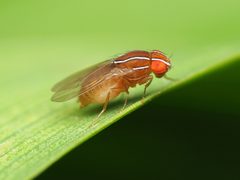
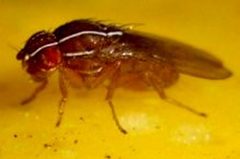
Zaprionus indianus is a highly drosophilid fruit fly native to West and Central Africa that has established across tropical and temperate regions worldwide. It is distinguished by striking longitudinal black and white stripes on the and . Unlike many invasive drosophilids, it cannot penetrate intact fruit skin and instead exploits pre-existing wounds or oviposition holes made by other , particularly spotted-wing drosophila (Drosophila suzukii). It is a significant pest of figs, grapes, and other soft fruits, and exhibits strong interspecific competitive ability.
Pronunciation
How to pronounce Zaprionus indianus: /zæpriˈoʊnəs ˈɪndiənəs/
These audio files are automatically generated. While they are not always 100% accurate, they are a good starting point.
Identification
The paired longitudinal black and white stripes on the and are diagnostic and readily distinguish Z. indianus from other drosophilids. The four respiratory filaments on (versus two in most drosophilids) provide a key diagnostic character for stages. The oviscapt lacks the large, serrated structure seen in Drosophila suzukii, consistent with its inability to penetrate intact fruit skin.
Images
Appearance
are reddish-brown drosophilid flies with distinctive paired longitudinal silver and black stripes running along the and (nota). The body is typical of small vinegar flies, approximately 3-4 mm in length. bear four respiratory filaments at one end, departing from the drosophilid norm of two filaments. Larvae have three instars with intersegmental spines, , maxillary palp complex, , , and and . Pupae have filaments originating from anterior spiracles with spines along these filaments.
Habitat
Associated with decomposing and overripe fruit in agricultural, orchard, and urban environments. In invaded temperate regions, is limited to protected areas or southern latitudes, with reinvading northern areas annually. Laboratory colonies are maintained on standard cornmeal-molasses medium at 25°C.
Distribution
Native to West and Central Africa; introduced and established across tropical regions worldwide including Brazil (since 1999), other South American countries, the Caribbean, southern Europe, the Middle East, India, and North America. In North America, first detected in Florida in 2005, with subsequent spread to the Mid-Atlantic, New England, Midwest, and southern Canada. Winter distribution in North America is limited to the deep South, but summer extend to Wisconsin, Minnesota, Ontario, and Quebec.
Seasonality
Activity is strongly seasonal in temperate regions, with peak captures during rainy or warm periods. In the Brazilian Cerrado, 97.4% of trap captures occurred during the rainy season. In North America, build through summer with peak activity in late summer and autumn; winter survival is restricted to southern latitudes with northern populations reestablishing annually through or local protected sites.
Diet
on decomposing and overripe fruits. Documented include figs (Ficus carica), grapes (Vitis vinifera), plums (Prunus salicina), tomatoes (Solanum lycopersicum), strawberries, raspberries, pawpaw (Asimina triloba), litchi (Litchi chinensis), monkey jack (Artocarpus lacucha), burflower tree (Neolamarckia cadamba), and over 80 host plant total. Cannot penetrate intact fruit skin; requires wounds, cracks, or pre-existing oviposition holes.
Host Associations
- Ficus carica - primary pest target; up to 80% in Brazilian orchards
- Vitis vinifera - wine grapes; often in grape clusters
- Prunus salicina - plums; first detection in Rio Grande do Sul, Brazil
- Solanum lycopersicum - tomatoes; especially injured or split fruit
- Asimina triloba - pawpaw; new record
- Litchi chinensis - litchi; new record from Bihar, India
- Artocarpus lacucha - monkey jack; new record from Bihar, India
- Neolamarckia cadamba - burflower tree; new record from Bihar, India
- Drosophila suzukii - competitor/kleptoparasiteexploits oviposition holes; kleptoparasitic relationship
Life Cycle
Post-embryonic development includes three larval instars following . occurs preferentially in the morning. Average time from pupation to is 5 days. Sex ratio is 1:1 overall, but females emerge in higher numbers during the first 72 hours of . Females reach sexual maturity at 5 days post-emergence. time can be less than two weeks under warm conditions.
Behavior
Mating requires vision; wings and courtship song are not necessary for successful copulation. Males use foretarsi to grasp females during copulation, which lasts 2-4 minutes (mean ~110 seconds). Unreceptive females perform a 'rocking' refusal when approached by males. Post-copulatory females continue rocking and refusal signals for at least six hours. Males are sperm-limited and cannot mate continuously; females become sperm-limited approximately 5 days after a single mating and benefit from . Exhibits kleptoparasitic behavior by depositing near or in oviposition holes made by Drosophila suzukii.
Ecological Role
pest that disrupts native drosophilid in invaded areas. Acts as a secondary pest that exploits damaged or overripe fruit, accelerating decomposition. Competes interspecifically with established drosophilids, often outcompeting Drosophila simulans and D. hydei under certain conditions. Serves as for including Pachycrepoideus vindemiae, Leptopilina heterotoma, and Leptopilina boulardi, though it exhibits partial enemy release in some contexts. Rapid wing size evolution has been documented following temperate .
Human Relevance
Significant agricultural pest of figs, grapes, and other soft fruits, causing economic losses in Brazil, the United States, and other invaded regions. Often detected in home environments associated with overripe fruit and compost. Can be managed with vinegar traps using apple cider vinegar or wine vinegar with dish detergent; trap is improved by combining banana-based olfactory lures with purple or yellow visual cues. Subject of scientific research on invasion , , and sperm limitation.
Similar Taxa
- Drosophila suzukiiBoth are drosophilids expanding globally; distinguished by D. suzukii's serrated oviscapt for penetrating intact fruit and lack of thoracic stripes
- Zaprionus tuberculatus with similar striped pattern; trap color preference differs, allowing -specific monitoring
More Details
Sperm limitation
Males produce sperm approximately 5 mm long (longer than body length), limiting mating capacity. Females benefit from remating to maintain offspring production.
Rapid evolution
Documented rapid wing size evolution following of temperate regions, suggesting adaptive potential in invaded range.
Enemy release
Strength of enemy release is context-dependent, varying with larval and competitor identity.
Sources and further reading
- BugGuide
- Wikipedia
- GBIF taxonomy match
- iNaturalist taxon
- NCBI Taxonomy
- Catalogue of Life
- African Fig Fly Meets Spotted-Wing Drosophila in the U.S.
- Bug of the Week
- Zaprionus indianus . [Distribution map].
- Zaprionus indianus . [Distribution map].
- Mating dynamics of a sperm-limited drosophilid, Zaprionus indianus
- Post-Embryonic Development inZaprionus indianus(Diptera: Drosophilidae)
- PARASITOIDS OF ZAPRIONUS INDIANUS GUPTA (DIPTERA: DROSOPHILIDAE) COLLECTED IN ITUMBIARA, GOIÁS, BRAZIL
- Alleviation of Arsenic Induced Neurobehavioral Defects with Selenium in the Larvae of Zaprionus Indianus
- Host-Parasitoid Relationship: Pachycrepoideus vindemmiae (Rondani) (Hymenoptera: Pteromalidae) collected in Zaprionus indianus Gupta (Diptera: Drosophilidae) in Brazil
- Effects of Pichia kudriavzevii on development, larval mortality and adult fecundity of Zaprionus indianus (Diptera: Drosophilidae) at different temperatures.
- Occurrence of Zaprionus indianus (Diptera: Drosophilidae) in Agudo, Rio Grande do Sul, Brazil
- Alleviation of arsenic induced neurobehavioral defects with selenium in the larvae of Zaprionus indianus
- Strength of enemy release from parasitoids is context-dependent in the invasive African Fig Fly, Zaprionus indianus
- Seeing and smelling invasion: visual–olfactory integration improves trap efficiency for the African fig fly Zaprionus indianus
- New host records of invasive species Zaprionus indianus (Gupta) (Diptera: Drosophilidae) from Bihar
- New Host Record for Drosophila suzukii and Zaprionus indianus (Drosophilidae: Diptera): Asimina triloba (Annonaceae: Magnoliales)
- Fuzzy AHP-based spatial distribution of fig tree cultivation in Zaprionus indianus infection risk for sustainable agriculture development
- Interactions of the Invasive Fruit Flies Drosophila suzukii, Zaprionus indianus, Zaprionus tuberculatus and Ceratitis capitata with Their Hosts in the Brazilian Pampa Biome.
- Limited population structure but signals of recent selection in introduced African Fig Fly (Zaprionus indianus) in North America.
- Rapid wing size evolution in African fig flies (Zaprionus indianus) following temperate colonization.