
Hemerodromiinae
dance flies
Tribe Guides
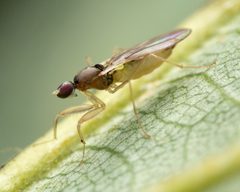
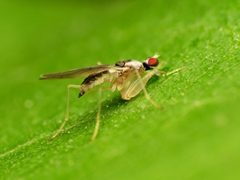
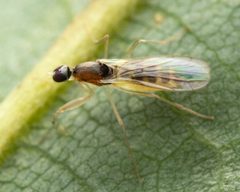
2Hemerodromiinae is a of predatory dance flies (Empididae) distributed worldwide. Members possess forelegs adapted for capturing prey. The subfamily contains two tribes: Chelipodini and Hemerodromiini, with numerous including Chelipoda, Hemerodromia, Chelifera, and Neoplasta. Many are associated with aquatic or semi-aquatic , particularly streams and moist environments.
Pronunciation
How to pronounce Hemerodromiinae: /ˌhɛmɪroʊˈdroʊmɪaɪni/
These audio files are automatically generated. While they are not always 100% accurate, they are a good starting point.
Identification
Hemerodromiinae are distinguished from other Empididae by forelegs with modified and tibiae adapted for seizing prey. Chelipodini typically have elongated bodies with reduced wing venation including loss of crossvein dm-cu in some lineages; Hemerodromiini generally have more robust bodies. Males of some exhibit pronounced with exaggerated characters. Separation from Clinocerinae requires examination of leg structure and wing venation details.
Images
Habitat
Primarily associated with lotic freshwater including streams, rivers, and spring runs. Many require moist substrates; some have obligate associations with calcareous streams and tufa formations in karst systems. Larvae develop in submerged decaying wood, moist soils, or stream substrates. often found in riparian vegetation or immediately adjacent to water bodies.
Distribution
Worldwide distribution with biogeographic patterns reflecting Gondwanan history. Present on all continents except Antarctica. High diversity in moist montane forests; in Southeast Asia, diversity peaks at upper-mid to sub-summit elevations (1500–2500 m). European fauna well-documented in Mediterranean, Balkan, and Central European regions. Southern Hemisphere lineages include relictual Gondwanan elements in New Zealand, New Caledonia, Lord Howe Island, and Vanuatu.
Seasonality
Most with in spring and summer. Some species present throughout the year in suitable ; winter occurrence recorded for select species in mild climates. Peak activity generally coincides with periods of high humidity and stable stream flows.
Diet
are predatory, feeding on small dipterans including . Larvae are predatory: those of Neoplasta parahebes feed on chironomid larvae in submerged wood tunnels. Specific prey ranges for most remain undocumented.
Life Cycle
, three larval instars, pupa, . Eggs laid under bark of submerged decaying wood or in moist substrates; incubation approximately 10–11 days at room temperature in studied . Larval development occurs in submerged wood or moist soils; in decaying wood or stream substrates. Larval densities can reach high levels (9.2 per 100 cm² wood surface recorded).
Behavior
are active using forelegs to capture flying or perched prey. Mating occurs in unidirectional position in studied . Adults of some species readily feed on prey smaller than themselves. Larvae are substrate-dwelling predators. Some species show microhabitat specificity for particular stream types or moisture regimes.
Ecological Role
in stream and riparian , regulating of and other small insects. Larvae contribute to decomposition processes in submerged wood . Serve as prey for larger aquatic and terrestrial predators. Indicator value for water quality and habitat integrity in some regions.
Human Relevance
Used as bioindicators of stream health and quality. Some rare and their habitats have been flagged for conservation protection. Subject of taxonomic and biogeographic research due to complex phylogenetic history and Gondwanan distribution patterns.
Similar Taxa
- ClinocerinaeAlso aquatic dance flies with predatory larvae; distinguished by leg structure and wing venation, particularly details of foreleg adaptations and male genitalia.
- EmpidinaeOther dance fly ; lacks the specialized foreleg structure of Hemerodromiinae and typically occupies different .
Sources and further reading
- BugGuide
- Wikipedia
- iNaturalist taxon
- NCBI Taxonomy
- Hemerodromiinae (Diptera: Empididae): a tentative phylogeny and biogeographical discussion
- The Hemerodromiinae (Diptera: Empididae) of New Zealand II. Chelipoda Macquart
- Life history of Neoplasta parahebes (Diptera: Empididae: Hemerodromiinae)
- Report on Brachystomatidae and Empididae (Hemerodromiinae, Clinocerinae) from continental Portugal and neighbouring countries
- New species of Hemerodromia Meigen (Diptera: Empididae: Hemerodromiinae) associated with limestone karstic waters in Thailand
- Aquatic dance flies of Czech Republic (Empididae: Clinocerinae and Hemerodromiinae): new records and updated species list
- Croatian aquatic dance flies (Diptera: Empididae: Clinocerinae and Hemerodromiinae): species diversity, distribution and relationship to surrounding countries
- First record of the rare aquatic dance fly Chelifera aperticauda Collin, 1927 (Diptera: Empididae: Hemerodromiinae) from Slovakia
- Aquatic dance flies (Diptera, Empididae, Clinocerinae and Hemerodromiinae) of Greece: species richness, distribution and description of five new species
- Emergence patterns and microhabitat preference of aquatic dance flies (Empididae; Clinocerinae and Hemerodromiinae) on a longitudinal gradient of barrage lake system
- Aquatic Empididae (Clinocerinae and Hemerodromiinae) of the upper course of the Neretva River with updated checklist for Bosnia and Herzegovina
- Elevational Gradients of Diversity and Species Composition of Hemerodromiinae (Diptera: Empididae) at Doi Inthanon, Thailand: Has Historical Partitioning between Seasonally Dry Lowland and Aseasonal Moist Mountain Forests Contributed to the Biodiversity o
- Figure 14 from: Ivković M, Ćevid J, Horvat B, Sinclair BJ (2017) Aquatic dance flies (Diptera, Empididae, Clinocerinae and Hemerodromiinae) of Greece: species richness, distribution and description of five new species. ZooKeys 724: 53-100. https://doi.org/10.3897/zookeys.724.21415
- Figure 13 from: Ivković M, Ćevid J, Horvat B, Sinclair BJ (2017) Aquatic dance flies (Diptera, Empididae, Clinocerinae and Hemerodromiinae) of Greece: species richness, distribution and description of five new species. ZooKeys 724: 53-100. https://doi.org/10.3897/zookeys.724.21415
- Figure 1 from: Ivković M, Ćevid J, Horvat B, Sinclair BJ (2017) Aquatic dance flies (Diptera, Empididae, Clinocerinae and Hemerodromiinae) of Greece: species richness, distribution and description of five new species. ZooKeys 724: 53-100. https://doi.org/10.3897/zookeys.724.21415