
Rhamphomyia longicauda
Loew, 1861
Long-tailed Dance Fly
Rhamphomyia longicauda is a dance fly renowned for its exceptional sex-role reversal in mating . Females form aerial at dawn and dusk, displaying inflated abdominal sacs and ornamental leg to attract males, who are the choosy sex. Females are obligate recipients of —prey items captured by males—because they cannot hunt for themselves. This nutritional dependence drives the reversal of typical courtship roles. The species has been extensively studied as a model for and the evolution of female ornamentation.
Pronunciation
How to pronounce Rhamphomyia longicauda: //ræmfoʊˈmaɪə lɒnɡɪˈkɔːdə//
These audio files are automatically generated. While they are not always 100% accurate, they are a good starting point.
Identification
Distinguished from other dance flies by the combination of female inflatable abdominal sacs, pinnate leg , and sex-role reversed lekking where females aggregate to display. Male genitalia with elbowed projection is diagnostic. Differs from in the specific of female ornaments and the aerial hovering formation 0.3–0.6m above ground under openings.
Images
Appearance
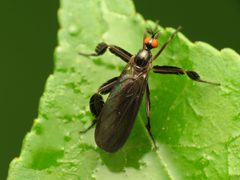
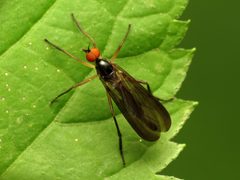
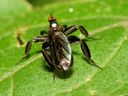
Sexually dimorphic. Males possess enlarged sections and shortened wings; the epithet 'longicauda' refers to the male's elbowed genitalia that projects rearward. Females have black pinnate projecting from middle and hind legs, small lateral leg hairs, and tan . Females display larger wings, length, and hind tibial length than males, plus enlarged inflatable sacs on the abdomen sides used in . Female retinas are enlarged relative to dorsal sections.
Habitat
Mating form under openings in otherwise closed , 0.3–0.6 meters above ground or vegetation. Swarming sites are typically located near water bodies. Males hunt within 30 meters of sites.
Distribution
Eastern North America; records include Vermont and broader US distribution in eastern regions.
Seasonality
activity primarily May through July; females congregate at sites 10 minutes before sunset and remain up to 40 minutes after dawn or before dusk.
Diet
Females are incapable of hunting and receive all protein from provided by males. Males are predatory, capturing swarming insects in figure-8 patterns; diet consists approximately 70% Diptera (flies), plus Ephemeroptera (mayflies), Trichoptera (caddisflies), and infrequently male ants, , and mosquitoes. Prey size ranges 2–4.5mm.
Life Cycle
presumably deposited in or near aquatic environments given swarming site association with water; detailed stages not documented in available sources.
Behavior
Exhibits one of the best-documented cases of sex-role reversal among insects. Females form of 10–100 individuals, hovering in horizontal planes rather than perching. Females inflate abdominal sacs with air and wrap legs around to exaggerate apparent size. They return to the same lek nightly even after insemination. Males hunt prey, then enter leks from below to offer ; females drop to males to receive gifts and mate in during 40-minute . Females with larger ornaments and shorter tibiae receive more copulations; larger females hover at lower swarm positions. Females do not engage in physical contests for position.
Ecological Role
Males function as of small flying insects. Both sexes serve as prey for web-building spiders, particularly Tetragnatha that construct webs at peripheries. Female swarming increases risk relative to males.
Human Relevance
Subject of extensive behavioral research as a model system for sex-role reversal, female ornament evolution, and theory. No documented economic or medical significance.
Similar Taxa
- Other Rhamphomyia speciesShare Empididae and general dance fly ; distinguished by specific female ornamentation (inflatable sacs, pinnate leg ) and documented sex-role reversal with aerial lekking in R. longicauda
- Other Empididae (dance flies)Share swarming but typically with conventional sex roles (male display, female choice); R. longicauda uniquely shows female lekking and male choosiness with obligate provisioning
More Details
Sexual selection dynamics
Female size correlates with maturity, but inflation reduces of this signal by 49%, representing deceptive signaling to attract males. Males prefer larger females but physical constraints—must bear female weight plus during copulatory , creating stabilizing selection on female size rather than directional selection.
Predation cost of reversed roles
Female swarming increases spider risk; females are captured more frequently than males despite not foraging, due to risky patterns near vegetation and possibly enlarged ornaments attracting attention.
Lek site fidelity
Females exhibit strong site fidelity, returning to identical locations nightly unless weather conditions prevent swarming (sustained rain or winds exceeding 14 km/h).
Sources and further reading
- BugGuide
- Wikipedia
- GBIF taxonomy match
- iNaturalist taxon
- NCBI Taxonomy
- Catalogue of Life
- Ten Facts You May Not Know About Tadpole Shrimp | Bug Squad
- Begone Tadpole Shrimps! They're 'Time Travelers' in Rice Fields | Bug Squad
- Outstanding Group of UC Davis Graduate Students at ESA Meeting | Bug Squad
- Visitors Marvel at Tadpole Shrimp at Bohart Museum Open House | Bug Squad
- Nuptial Gifts and Other Romantic Gestures of the Bug World
- Bug Eric: What the Insects Have Taught Me
- Biology of the Longtailed Dance Fly, Rhamphomyia longicauda (Diptera: Enipididae); a New Look at Swarming1
- FEMALE MATING SWARMS INCREASE PREDATION RISK IN A 'ROLE-REVERSED' DANCE FLY (DIPTERA: EMPIDIDAE: RHAMPHOMYIA LONGICAUDA LOEW)
- Contrasting sexual selection on males and females in a role‐reversed swarming dance fly, Rhamphomyia longicauda Loew (Diptera: Empididae)