
Condylostylus scaber
long-legged fly
Condylostylus scaber is a of long-legged fly in the Dolichopodidae. These small, metallic flies are active of other small insects. The Condylostylus includes species commonly observed in gardens and forest edges across North America. Like other dolichopodids, they are known for their agility and rapid, darting patterns.
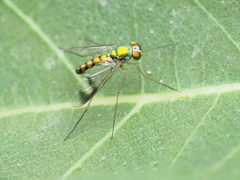
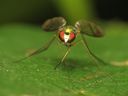
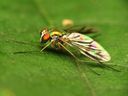
Pronunciation
How to pronounce Condylostylus scaber: /ˌkɒn.dɪ.ləˈstaɪ.ləs ˈskeɪ.bər/
These audio files are automatically generated. While they are not always 100% accurate, they are a good starting point.
Identification
Difficult to distinguish from other Condylostylus without examination of male genitalia. The Condylostylus can be recognized by the combination of metallic coloration, long legs, and typical dolichopodid body plan. Species-level identification generally requires microscopic examination of male terminalia. Separated from other dolichopodid genera by subtle morphological characters of the legs and .
Images
Habitat
Gardens, forest edges, and similar sunny with vegetation. Found on foliage in open, sunlit areas where they actively hunt prey.
Distribution
North America; specifically documented from Illinois and surrounding regions. The Condylostylus is broadly distributed across the continent.
Seasonality
Active during warm months when sunny conditions prevail; specific for this is not well documented.
Diet
Predatory on other small insects. Prey likely includes various small soft-bodied arthropods encountered on vegetation.
Life Cycle
Complete with , larva, pupa, and stages. Larval of this is unknown. Dolichopodid larvae are generally predatory and may be aquatic, semi-aquatic, or terrestrial depending on .
Behavior
exhibit rapid, darting and are rarely stationary, making observation and photography challenging. Males perform complex using specialized structures on the front . Sensitive to camera pre-flash, often departing before image capture.
Ecological Role
of small insects in vegetation . Contributes to regulation of in gardens and natural edge .
Human Relevance
Potential value as agent in garden settings. Observed and photographed by naturalists, though challenging to capture due to rapid movement.
Similar Taxa
- Other Condylostylus speciesNearly indistinguishable without male genitalia examination; -level characters shared
- Dolichopus speciesSimilar metallic appearance and long legs; males of Dolichopus have distinctive scaled ornaments on front not present in Condylostylus
- Hydrophorus speciesSimilar characteristics but associated with water surfaces rather than foliage; exhibit skating on water
More Details
Taxonomic challenges
The Dolichopodidae contains approximately 1,300 in North America north of Mexico across nearly 60 . Species-level identification is notoriously difficult and typically requires examination of male genitalia.
Photography difficulties
The combination of small size, constant movement, and sensitivity to camera pre-flash makes this and related particularly challenging subjects for macrophotography.