
Deuterophlebia
Edwards, 1922
mountain midges
Species Guides
1Deuterophlebia is the sole extant of the Deuterophlebiidae, commonly called mountain midges. This group represents a highly specialized lineage of Diptera with a basal phylogenetic position, considered by some as the sister group to all other extant flies. The genus comprises approximately fourteen described distributed primarily across temperate regions of the Northern Hemisphere. are characterized by extreme in length and brief, non-feeding lifespans measured in hours. Larvae and pupae are strictly aquatic, inhabiting cold, fast-flowing montane streams where they exhibit remarkable morphological adaptations for life in turbulent water.
Pronunciation
How to pronounce Deuterophlebia: /ˌdjuːtəroʊˈfliːbiə/
These audio files are automatically generated. While they are not always 100% accurate, they are a good starting point.
Identification
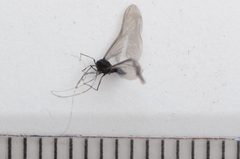
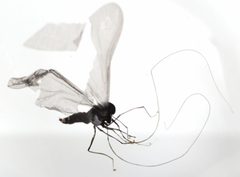
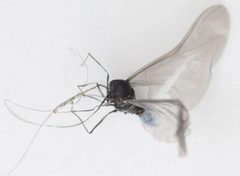
: Males distinguished by extremely long (9–10 mm vs. ~0.5 mm in females); identify to using chaetotaxy, flagellomere length ratios, leg proportions, microtrichia on postgena, and shape. Pupae: Recognized by thoracic spines and abdominal bands. Larvae: Separated by setae patterns on and ; forked antennae and abdominal diagnostic for .
Images
Habitat
Strictly associated with fast-flowing, cold, well-oxygenated mountain streams and rivers. Larvae and pupae occur on submerged rock surfaces in sections of rapids. form swarms directly above rushing water. Extreme specialization contributes to fragmented distribution.
Distribution
Primarily Holarctic: Asian Palearctic (Afghanistan, Kashmir, Northeast India, China, Japan, Korea, Eastern Siberia, Mongolia, Kyrgyzstan, Russia) and Nearctic (western North America from Alaska through California to Colorado). Recent discoveries in Sichuan, Yunnan, and Fujian provinces of China extend range into . Previously recorded twice from far northwest China; central areas historically uninvestigated.
Seasonality
emerge at dawn to form brief swarms. Activity timing tied to from aquatic stages in mountain streams.
Life Cycle
Holometabolous with aquatic larval and pupal stages and terrestrial stage. Larvae graze on rock surfaces in turbulent water using specialized . Pupae occur on same stones in crevices. Adults emerge at dawn, do not feed, live only a few hours, mate in swarms above water. Females reportedly submerge to lay on submerged substrates and may shed wings during this process, though direct observation is rare.
Behavior
Males defend territories above running water and perform displays using oversized while awaiting emerging females. form brief swarms at dawn. Females enter water to oviposit, a rare among adult Diptera.
Ecological Role
Larvae graze on fine organic detritus and microbial films in stream . serve as prey for spiders (documented by specimens recovered from webs). Component of specialized aquatic in montane streams.
Human Relevance
Of scientific interest due to basal phylogenetic position within Diptera; considered sister lineage to all other extant flies in recent molecular . Subject of biogeographic and evolutionary studies. No known economic importance or direct human impact.
Similar Taxa
- Blephariceridae (net-winged midges)Also inhabit fast-flowing streams with dorsoventrally flattened larvae; distinguished by wing venation with net-like pattern and larval with sucking disks rather than hook-tipped .
- Other Diptera familiesDeuterophlebiidae uniquely combines: male extremely elongated (9+ mm), non-feeding with mouthparts, larval with hooks, and female oviposition by submerging and shedding wings.
More Details
Phylogenetic significance
Molecular identify Deuterophlebiidae as sister to all other extant Diptera, representing a basal evolutionary lineage. Some classifications place the in its own infraorder Deuterophlebiomorpha, though this is not widely accepted.
Fossil record
Fossil Deuterophlebiidae described from mid-Cretaceous Burmese amber (~100 million years ago) indicate morphological conservatism since the Mesozoic.
Species diversity
China currently holds the highest documented for the following recent descriptions of multiple new (D. sinensis, D. yunnanensis, D. wuyiensis, D. acutirhina, D. alata, D. pseudopoda, D. pachychaeta).
Sources and further reading
- BugGuide
- Wikipedia
- GBIF taxonomy match
- iNaturalist taxon
- NCBI Taxonomy
- Catalogue of Life
- Two new species of Deuterophlebia Edwards, 1922 from Southwestern China (Diptera, Deuterophlebiidae)
- Biology and Life History of a New Species of Mountain Midge, Deuterophlebia nielsoni, from Eastern California (Diptera: Deuterophlebiidae)
- Descriptions and Barcoding of Five New Chinese Deuterophlebia Species Revealing This Genus in Both Holarctic and Oriental Realms (Diptera: Deuterophlebiidae)