
Deuterophlebiidae
Edwards, 1922
Mountain Midges
Genus Guides
1- Deuterophlebia(mountain midges)
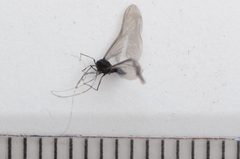
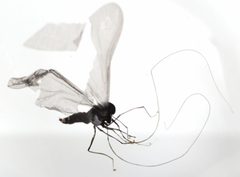
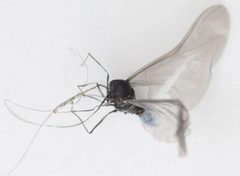
is a of Diptera containing the single Deuterophlebia, considered the most plesiomorphic extant dipteran family based on morphological and molecular evidence. Commonly known as mountain midges, these insects inhabit cold, fast-flowing streams across the Holarctic region. possess striking including extremely long in males, broad fan-shaped wings, and highly reduced mouthparts. Larvae are specialized for life in torrential waters with reversible crocheted pseudopods for attachment to smooth stones. The family exhibits a complex with extended larval and pupal periods and extremely brief adult longevity lasting only a few hours.
Pronunciation
How to pronounce Deuterophlebiidae: //ˌdjuː.tə.roʊˈflɛ.bɪ.aɪˌdiː//
These audio files are automatically generated. While they are not always 100% accurate, they are a good starting point.
Identification
distinguished from other by combination of extremely long male , broad fan-shaped wings, and reduced mouthparts. Larvae identified by forked antennae and presence of reversible crocheted pseudopods—structures unique among Diptera. Pupae recognized by streamlined body with adhesive disk and often by presence of mesothoracic spines or abdominal projections (-specific). Distinguished from Blephariceridae (other torrent-dwelling ) by larval crocheted pseudopods versus suctorial discs. Species-level identification requires examination of male terminalia, flagellomere length ratios, chaetotaxy, microtrichia on postgena, shape, and pupal thoracic spine patterns.
Images
Habitat
Cold, fast-flowing streams and rapids with smooth stone substrates. Waters are typically stenothermal (cold-loving), lotic, and well-oxygenated. Surrounding terrestrial include forests, grasslands, and shrublands. Stream width approximately 1.5 m and depth approximately 1.2 m at documented localities; requires unobstructed flow with stones of various sizes.
Distribution
Holarctic distribution encompassing Palearctic and Nearctic realms. Asia: highest diversity in China with nine described from Yunnan, Fujian, Xinjiang, and other provinces; also recorded from Kashmir, India. North America: two described species from western regions including California and Alberta, Canada.
Seasonality
hatch August–September. Larval development occurs August–December. Pupae form August–December and overwinter for approximately three months. March–April following temperature rise, with mating at sunrise. Total development period exceeds six months.
Host Associations
- Sperchon - Larval water mites (Acari: Sperchontidae) parasitize Deuterophlebia, attaching preferentially to during from pupa to adult. Engorgement completed within hours.
Life Cycle
are laid in water by females after wing shedding. Larvae hatch August–September and develop through three instars until December, using reversible crocheted pseudopods to maintain position on stones in fast currents. Third instar larvae possess black prothorax. occurs August–December; pupae attach tightly to stones via disk and overwinter for three months. emerge March–April after temperature increase. Adult stage lasts only a few hours; males die immediately after mating.
Behavior
Larvae perch on smooth stones using reversible crocheted pseudopods, maintaining position in torrential flow. Pupae remain tightly attached to substrates, often co-occurring with Simuliidae larvae. Males engage in territorial contests over running water at sunrise, using extremely long in displays while awaiting female . Females shed wings after mating and return to water to oviposit. do not feed.
Ecological Role
Specialized inhabitant of cold, fast-flowing stream . Larvae contribute to processing of organic matter in torrential . Serve as for larval water mites (Sperchontidae), providing a trophic link between aquatic and terrestrial . Brief may provide pulse resource for .
Human Relevance
Subject of phylogenetic and evolutionary research due to status as most plesiomorphic extant Diptera . Indicator of high-quality coldwater stream . No known economic importance or pest status.
Similar Taxa
- BlephariceridaeBoth are specialized torrent-dwelling with streamlined larvae and pupae adapted to fast-flowing water. Distinguished by larval attachment structures: have reversible crocheted pseudopods while Blephariceridae possess suctorial discs.
- SimuliidaeBlack flies share similar aquatic and often co-occur with pupae on stones. Distinguished by very different larval including labral fans for filter-feeding and lack of crocheted pseudopods.
Sources and further reading
- BugGuide
- GBIF taxonomy match
- iNaturalist taxon
- NCBI Taxonomy
- Catalogue of Life
- First Record of the Family Deuterophlebiidae in Canada (Diptera)
- Two new species of Deuterophlebia Edwards, 1922 from Southwestern China (Diptera, Deuterophlebiidae)
- Description of a New Species of Mountain Midges (Diptera, Deuterophlebiidae) from Xinjiang, China
- Biology and Life History of a New Species of Mountain Midge, Deuterophlebia nielsoni, from Eastern California (Diptera: Deuterophlebiidae)
- FIRST RECORD OF LARVAL WATER MITES (ACARI: LEBERTIOIDEA: SPERCHONTIDAE) PARASITIC ON MOUNTAIN MIDGES (DIPTERA: DEUTEROPHLEBIIDAE)
- Cuticular morphology of larval mountain midges (Diptera: Deuterophlebiidae): implications for the phylogenetic relationships of Nematocera
- Descriptions and Barcoding of Five New Chinese Deuterophlebia Species Revealing This Genus in Both Holarctic and Oriental Realms (Diptera: Deuterophlebiidae)
- Correction: Wang et al. Description of a New Species of Mountain Midges (Diptera, Deuterophlebiidae) from Xinjiang, China. Insects 2025, 16, 965.
- First fossil mountain midges (Diptera, Deuterophlebiidae) and their evolutionary and ecological implication.