
Toxorhynchites rutilus
(Coquillett, 1896)
Elephant Mosquito, Treehole Predatory Mosquito, Predatory Tree-hole Mosquito
Toxorhynchites rutilus, commonly called the elephant mosquito, is a large predatory mosquito native to North America. are distinctive for their iridescent blue-purple coloration, large size, and non-biting habit—they feed exclusively on nectar and serve as . The larvae are obligate that consume other mosquito larvae, making this species valuable for of - mosquitoes. A single larva may eat up to 5,000 prey larvae before maturing. The species has been employed in biocontrol programs targeting container-breeding Aedes mosquitoes.
Pronunciation
How to pronounce Toxorhynchites rutilus: /ˌtɒksəˌrɪŋˈkiːtiːz ˈruːtɪləs/
These audio files are automatically generated. While they are not always 100% accurate, they are a good starting point.
Identification
Distinguished from other mosquitoes by large size, iridescent metallic coloration, and strongly curved . active at dusk are surprisingly cryptic despite their brilliance. Larvae identifiable by reddish color, short anal siphon, and predatory . Most reliably separated from other Toxorhynchites by geographic range and male palp .
Images
Appearance
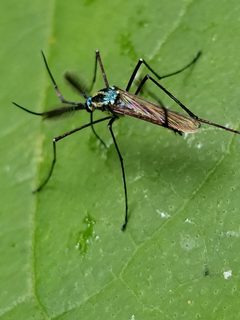
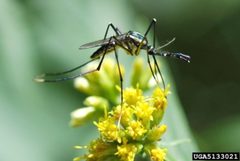
Large mosquito with wingspan approaching half an inch. display iridescent blue and purple coloration with silver and gold highlights, and white tips on the hind legs. Males have long, upcurved palps resembling elephant tusks, giving the its . Females have straight palps. Both sexes possess a distinctive bent sharply downward near the middle. Larvae are reddish with a short anal siphon, broad black , and strong .
Habitat
Breeds in water-filled tree cavities and artificial containers including flower pots, rain barrels, cans, pet watering bowls, pails, and tires. Shares breeding sites with Aedes . In northern portions of its range, larvae undergo in response to short . Suitable defined bioclimatically by mean temperature of warmest quarter 22.6°C to 29.1°C, precipitation 1,025–1,529 mm, and precipitation seasonality ≤17.86.
Distribution
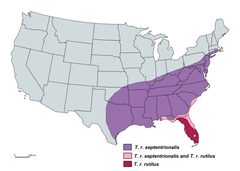
North America: eastern half of Texas and Oklahoma diagonally northeast to southern Pennsylvania, Connecticut, and Delaware. Center of current distribution in central Tennessee, USA. T. r. septentrionalis extends into southern Ontario, Canada (first recorded at Point Pelee National Park). Middle America also indicated in distribution records. Climate projections suggest north-northeast shift of 98–280 km by 2070.
Seasonality
active in late autumn in northeast Kansas; considered day-fliers but most active at dusk. Oviposition is with minor peak during first hour of photophase and major peak during hour preceding evening twilight. In northern , long days promote rapid development while short days retard development and evoke in fourth instar larvae; critical for diapause maintenance around 13 hours light per day.
Diet
Life Cycle
Four larval instars. Development from to can take several weeks to six months depending on conditions. Females lay white, football-shaped eggs individually in , launching them into water from in looping flight patterns above the surface. Mean total eggs laid per female approximately 39 over 15 days, with mean 62 mature eggs retained. controls development rate and induction in northern .
Behavior
Larval involves harpoon-like extension: larvae build pressure in abdominal segments and rapidly release it to launch head toward prey, with and sensory brushes snapping closed on impact. Strike duration approximately 15 milliseconds. exhibit cryptic in dim light despite bright coloration. Females show oviposition preference for water containing Aedes aegypti rearing medium over deionized water.
Ecological Role
Human Relevance
Employed as biocontrol agent against - mosquitoes in Japan, southeast Asia, the Caribbean, and United States cities. Laboratory rearing for release programs requires individual larval housing to prevent . pose no biting nuisance or disease transmission risk. Climate change may expand suitable for biocontrol use in North America.
Similar Taxa
- Toxorhynchites amboinensisSimilar predatory larval and ; distinguished by lower search rate for (0.23 vs 0.47 searches/min in T. rutilus) and geographic distribution.
- Culex antillummagnorumConvergent -laying with aerial oviposition; distinguished by being a true Culex with different and non-predatory larvae.
- Sabethes cyaneusShares predatory larval habit but uses tail-sweeping rather than -extension to capture prey; have distinctive iridescent blue coloration and feather-like leg paddles.
Misconceptions
Despite 'elephant mosquito,' not related to crane flies (sometimes called 'mosquito hawks'). do not bite humans or animals despite being mosquitoes—often surprising to the public. Large size sometimes mistaken for dangerous , but adults are harmless nectar-feeders.
More Details
Biocontrol Production Methods
Mass rearing requires individual larval rearing to prevent . Early instars require live food (microworm Panagrellus) to trigger feeding response; later instars accept frozen bloodworms. Hurricane Harvey destroyed the Harris County, Texas rearing facility in 2017, though the colony was evacuated.
Photoperiodic Adaptation
Northern exhibit developmental plasticity: long days (>13 hours) avert and accelerate growth, while short days induce diapause in fourth instar. Winter conditions play prominent role in diapause maintenance and termination in northern range.
Sources and further reading
- BugGuide
- GBIF taxonomy match
- iNaturalist taxon
- NCBI Taxonomy
- Bug Eric: Fly Day Friday: The Good Mosquito
- Meet the Mosquito With a Big Appetite—for Other Mosquitoes
- Unique Egg-Laying Behavior Re-Discovered in Culex Mosquito Species
- Harpoon Heads, Sweeping Tails: How Predatory Mosquito Larvae Capture Prey
- The Best of 2022 on Entomology Today
- Entomologists Discuss Discovery's "Mosquito" Documentary: A Live-Tweet Recap
- Search Behavior Associated with Egg Cannibalism in Toxorhynchites amboinensis and Toxorhynchites rutilus rutilus (Diptera: Culicidae)
- Potential Distribution of the Biocontrol Agent Toxorhynchites rutilus By 2070
- Larval Chaetotaxy and Notes on the Biology of Toxorhynchites rutilus septentrionalis (Diptera: Culicidae)
- Laboratory observations on oviposition by the predaceous tree-hole mosquito, Toxorhynchites rutilus septentrionalis (Diptera: Culicidae)
- Biology of tree-hole mosquitoes: photoperiodic control of development in northern Toxorhynchites rutilus (Coq.)
- Ecology of Aedes species: Factors influencing larval abundance in artificial treeholes in the Panhandle of Florida after Toxorhynchites r. rutilus releases
- THE BIOLOGY OF THE TREE-HOLES OF POINT PELEE NATIONAL PARK, ONTARIO: II. FIRST RECORD OF TOXORHYNCHITES RUTILUS SEPTENTRIONALIS IN CANADA (DIPTERA: CULICIDAE)