
Telmatogeton japonicus
Tokunaga, 1933
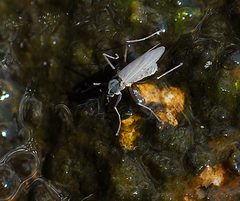
Telmatogeton japonicus is a marine described from Japan in 1933. It has been introduced to coastal areas of North America and Europe, where it has been recorded from the Wadden Sea and Belgian marine waters. The species belongs to the Telmatogetoninae, a group of midges specialized for intertidal and marine environments.
Pronunciation
How to pronounce Telmatogeton japonicus: /tɛlˌmætəˈdʒiːtən dʒəˈpɒnɪkəs/
These audio files are automatically generated. While they are not always 100% accurate, they are a good starting point.
Identification
Members of the Telmatogeton can be distinguished from other Chironomidae by their to marine environments, including to salinity and association with intertidal . Specific identification of T. japonicus requires examination of genitalia and pupal characteristics; the was originally described based on morphological features distinct from congeneric species in Japan.
Images
Habitat
Marine and intertidal environments. In its introduced range, it has been recorded from coastal marine waters including the Wadden Sea and the North Sea off Belgium.
Distribution
Native to Japan. Introduced to North America and Europe, with confirmed records from the Wadden Sea, Belgian marine waters, and the Flemish Region of Belgium.
Human Relevance
The is of interest as a documented case of marine insect introduction across continents, though specific economic or ecological impacts have not been quantified.
Similar Taxa
- Telmatogeton natalensisAnother marine Telmatogeton with intertidal distribution; separation requires detailed morphological examination of and pupae
- Other ChironomidaeMost chironomids are freshwater; Telmatogeton are distinguished by marine association and morphological adaptations to saline environments
More Details
Taxonomic History
Described by Tokunaga in 1933 from Japanese material. The Telmatogetoninae contains only a few and represents an unusual marine radiation within the otherwise predominantly freshwater Chironomidae.
Invasion Biology
The mechanism of introduction to Europe and North America is unknown, but may involve shipping or aquaculture activities. The appears established in the Wadden Sea and Belgian coastal waters.