
Tanypus
Meigen, 1803
non-biting midges
Species Guides
3Tanypus is a of non-biting midges in the Chironomidae, Tanypodinae, comprising at least 100 described . Larvae are aquatic and benthic, occurring in freshwater lakes and other lentic environments. Species within the genus exhibit bioturbation activity that modifies sediment oxygen dynamics. patterns vary by species, with some showing multivoltine and specific strategies.
Pronunciation
How to pronounce Tanypus: /ˈtænɪpəs/
These audio files are automatically generated. While they are not always 100% accurate, they are a good starting point.
Identification
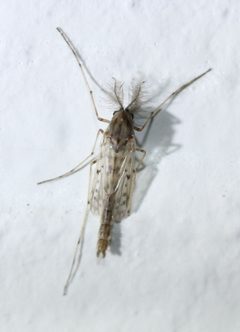
Larvae of Tanypus can be distinguished from other by their reduced or modified and specific mandibular structures characteristic of Tanypodinae. are small, delicate flies with reduced mouthparts (non-biting). -level identification requires examination of male genitalia and pupal .
Images
Habitat
Freshwater lentic environments, primarily lakes and ponds. Larvae inhabit benthic sediments, with over 90% of individuals typically found in the top 7.5 cm of substratum. Depth of penetration increases with later instars. Specific microhabitat preferences vary by and developmental stage.
Distribution
distribution with documented in North America (Utah Lake), Europe (Lake Balaton, Hungary), and Asia (Lake Taihu, China). At least 100 described occur across multiple continents.
Seasonality
Varies by and latitude. Tanypus stellatus in Utah Lake shows with peaks in early July and August, with larvae in first and second instar. Tanypus punctipennis in Lake Balaton exhibits trivoltine cycles with long, interrupted emergence periods from spring through autumn.
Life Cycle
Aquatic larvae develop through four instars before . strategies vary: T. stellatus overwinters as early instars (first and second), while other may overwinter as later instars. Some species show multivoltine cycles ( or trivoltine) with overlapping and parallel cohorts. periods can be extended and interrupted rather than discrete pulses.
Behavior
Larvae exhibit bioturbation activity in surface sediments, actively burrowing and enhancing oxygen penetration depth and exchange rates across the sediment-water interface. T. stellatus larvae show contagious distribution patterns in early instars, trending toward random distribution with age.
Ecological Role
Benthic component of freshwater lake . Functions as an ecosystem engineer through bioturbation, modifying sediment oxygen dynamics by increasing penetration depth (from ~6 mm to ~10 mm in studied conditions) and enhancing oxygen exchange at the sediment-water interface. Metabolic activity consumes oxygen within sediments. Serves as food source for fish and other aquatic .
Human Relevance
Ecologically important as indicators of lake condition and contributors to nutrient cycling. Larvae may be collected as fish food or . Some may occur in eutrophic or degraded waters, potentially serving as bioindicators.
Similar Taxa
- ProcladiusBoth are tanypodine chironomids with reduced ; distinguished by differences in mandibular structure and larval capsule
- ChironomusBoth are with aquatic larvae; Tanypus larvae typically remain in shallower sediment layers and show different bioturbation patterns, while Chironomus larvae often penetrate deeper into anoxic sediments
- LimnodrilusBoth are benthic bioturbators in freshwater sediments; Tanypus is an insect (Diptera) with stronger effects on oxygen penetration depth compared to this oligochaete worm in comparative studies
More Details
Bioturbation significance
Tanypus chinensis has been demonstrated to significantly alter sediment oxygen profiles, increasing penetration depth by approximately 67% (from 6 mm to 10 mm) in experimental conditions, indicating substantial engineering capacity.
Population distribution patterns
Larval distribution varies with instar: early instars show contagious (clumped) distributions, while older larvae tend toward random spatial distribution, likely reflecting behavioral changes or -dependent factors.
Sources and further reading
- BugGuide
- Wikipedia
- iNaturalist taxon
- NCBI Taxonomy
- Catalogue of Life
- BIOTURBATION EFFECTS OF TANYPUS CHINENSIS AND LIMNODRILUS HOFFMEISTERI ON PENETRATION AND DISTRIBUTION OF SEDIMENT OXYGEN
- Life history patterns of Procladius choreus, Tanypus punctipennis and Chironomus balatonicus in Lake Balaton
- The Microdistribution and Population Trends of Larval Tanypus Stellatus Coquillett and Chironomus Frommeri Atchley and Martin (Diptera: Chironomidae) in Utah Lake, Utah