
Culicoides
Latreille, 1809
biting midges, no-see-ums
Species Guides
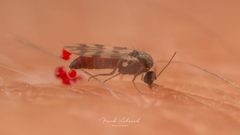
3is a of over 1,000 of biting midges in the Ceratopogonidae. These tiny flies, measuring 1–3 mm in length, are significant of animal including bluetongue virus, hemorrhagic virus, and Schmallenberg virus. Only females take blood meals, required for maturation, while both sexes feed on nectar. The genus has a fossil record extending to approximately 99 million years ago in Burmese amber.
Pronunciation
How to pronounce Culicoides: //ˌkjuːlɪˈkɔɪdiːz//
These audio files are automatically generated. While they are not always 100% accurate, they are a good starting point.
Identification
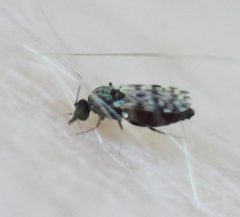
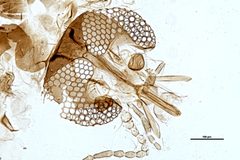
can be distinguished from mosquitoes by their smaller size, lack of a , and wing venation with only two distinct longitudinal . Within Ceratopogonidae, identification requires examination of wing patterns, antennal , and male genitalia. The is divided into numerous subgenera including Avaritia, Culicoides, Monoculicoides, and Oecacta, though phylogenetic relationships remain unresolved. such as the Obsoletus complex and Pulicaris complex contain morphologically similar species requiring molecular methods for accurate identification.
Images
Habitat
Larval include water vegetation, slow-running streams, damp soil, and manure heaps—typically at the soil-water interface of semi-aquatic areas such as pond margins or marshes. are often found in the vicinity of water, marshes, or rotting vegetation. Some stratify vertically in forest rather than remaining near ground level.
Distribution
Worldwide distribution with records from North America, South America, Europe, Africa, and Asia. Notable records include Colombia (Amazonas, Antioquia, Boyacá, Caquetá, Cauca, Cesar, Chocó, Cundinamarca, Guaviare, Huila, Magdalena, Meta, Putumayo, Tolima, Valle del Cauca, Vaupés), Denmark, Norway, and Sweden. Specific study documented from southeast England and southern California dairy regions.
Seasonality
Activity patterns vary by and climate. In temperate regions, activity peaks at 20–25°C with reduced activity below 10°C and above 35°C. Seasonal variation in temperature thresholds occurs, with spring active at lower temperatures than summer and autumn populations. In southern California, -seeking activity continues throughout winter on warmer days. Females typically bite at dusk or dawn.
Diet
Both males and females feed on nectar. Females require blood meals for maturation of fertilized . include livestock, wild mammals, equines, and humans. Specific blood meal sources vary by , with some species ornithophilic and others mammalophilic.
Host Associations
- livestock - Primary for many ; source of blood meals
- wild mammals - Includes white-tailed deer, important for hemorrhagic virus transmission
- equines - Horses serve as ; studied in UK
- humans - Some bite humans, causing irritating lumps
- reptiles - Reported for some groups
Life Cycle
Females lay en masse in aquatic or semi-aquatic . Eggs hatch into tiny smooth white larvae with four pairs of anal gills. Pupae consist of a with slender respiratory trumpets and a segmented . emerge through a straight slit after 3–7 days. Adult lifespan estimated at less than 30 days in winter conditions. Multiple occur per year in suitable climates.
Behavior
Females bite at dusk or dawn, often in dense swarms. activity is strongly temperature-dependent, with optimal activity at 20–25°C. Flight activity and survival are significantly reduced under low humidity conditions (<50% relative humidity). Some exhibit vertical stratification in forests, with individuals found in greater abundance in tree than near ground level. -seeking occurs year-round in warmer climates on suitable days. Infected sonorensis carrying bluetongue virus have been observed to be repelled by light.
Ecological Role
Biological of internationally important including bluetongue virus, hemorrhagic virus, Schmallenberg virus, African horse sickness virus, Oropouche virus, Akabane virus, and vesicular stomatitis virus. Also transmit filarial (Mansonella spp.), Onchocerca , and protozoan including Leucocytozoon, Plasmodium agamae, and Hepatocystis. Wind-borne facilitates long-distance spread of -borne diseases. Role in pollination through nectar feeding is likely but unquantified.
Human Relevance
Significant veterinary and economic importance as of livestock . Bluetongue virus and hemorrhagic disease virus cause severe morbidity and mortality in cattle, sheep, and deer, with estimated losses of $30 million in Florida alone from a 2012 EHDV . Bites to humans cause sharp pricks and irritating lumps lasting hours to days. Oropouche virus, historically confined to the Amazon basin, has expanded to other regions of South America and Cuba, with human fatalities and to unborn children reported in 2024. Control efforts are hampered by difficulty in targeting larval stages; silver nanoparticles show promise as in proof-of-concept studies. Light traps used for monitoring have limitations and may underestimate vector or draw infected vectors near human habitations.
Similar Taxa
- Mosquitoes (Culicidae)Both are small, blood-feeding with aquatic larvae, but lacks a , has distinct wing venation with only two longitudinal , and is much smaller (1–3 mm vs. typically 3–6 mm or larger)
- Other Ceratopogonidae genera is distinguished by combination of wing venation, antennal structure, and genital ; many former subgenera occasionally elevated to status, creating taxonomic confusion
- Phlebotomus (sand flies)Similar size and biting habit, but sand flies have different wing venation, longer legs relative to body, and transmit different groups (Leishmania, Bartonella, phleboviruses)
Misconceptions
are frequently mistaken for mosquitoes due to similar size and blood-feeding , but they belong to a different (Ceratopogonidae vs. Culicidae) and have distinct morphological and ecological traits. The 'no-see-ums' reflects their small size and ability to pass through standard insect screens. Light trap data have historically led to misconceptions about activity patterns, suggesting dawn-to-dusk activity and winter inactivity, when some are actually or and active year-round in suitable conditions.
More Details
Taxonomic instability
The of are described as 'phylogenetic chaos' due to traditional classification approaches. Molecular phylogenetic studies have validated some subgenera (Monoculicoides, Culicoides, Haematomyidium, Hoffmania, Remmia, Avaritia) as monophyletic while finding others (Oecacta) . The subgenus Remmia was validated as distinct from Oecacta in 2017. -level identification remains challenging, with many species of unknown relation to established subgenera.
Overwintering and virus persistence
In temperate regions, bluetongue virus persists through continuous low-level transmission during winter rather than or long-lived infected . -seeking activity continues on warmer winter days, with continuous of new adults from maintaining the transmission cycle.
Control challenges
are notoriously difficult to control. Larval are diverse and often inaccessible, making targeted treatment difficult. control is complicated by activity during periods and attraction to over long distances. Current research focuses on characterizing larval habitats, understanding phenological patterns, and developing novel control agents such as silver nanoparticles.
Sources and further reading
- BugGuide
- Wikipedia
- GBIF taxonomy match
- iNaturalist taxon
- NCBI Taxonomy
- Catalogue of Life
- Treasured Comments About Insects: Can We Hear a Collective 'Sigh?' | Bug Squad
- Could Silver Nanoparticles Be a New Tool to Manage Biting Midges?
- Biting Midges' Overwintering Activity Offers Clues to Persistence of Bluetongue Virus
- Oh, Deer! How One Entomologist Works to Improve Wildlife and Livestock Health
- Pest Management in Deer Farming: First Steps Toward Best Practices
- Beware the "Dark Side" of Light Traps
- Temperature and humidity limits for flight activity of field-collected Culicoides biting midges (Diptera: Ceratopogonidae) in the United Kingdom under defined laboratory conditions.