
Thaumatomyia
Zenker, 1833
cereal flies, frit flies
Species Guides
7- Thaumatomyia annulata(grass fly)
- Thaumatomyia apache
- Thaumatomyia glabra(grass fly)
- Thaumatomyia grata(grass fly)
- Thaumatomyia pulla(grass fly)
- Thaumatomyia pullipes
- Thaumatomyia rubida(grass fly)
Thaumatomyia is a of small flies in the Chloropidae, commonly known as cereal flies or frit flies. The genus includes with divergent larval ecologies: some are predatory on root aphids in agricultural soils, while others have been observed feeding on plant exudates. Several species are recognized as important agents of root aphids in sugar beet and cereal crops in Middle Asia.
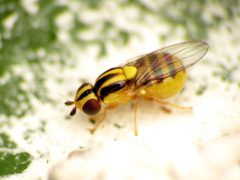
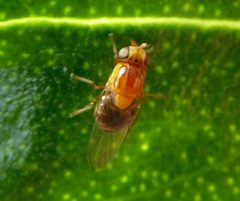
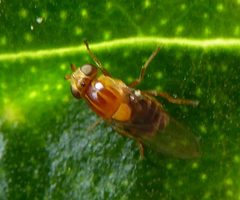
Pronunciation
How to pronounce Thaumatomyia: /θɔːməˈtɒmiə/
These audio files are automatically generated. While they are not always 100% accurate, they are a good starting point.
Identification
Members of Thaumatomyia can be distinguished from other Chloropidae by the combination of: ocellar triangle with distinct microchaetotaxy; with specific segment proportions; and body size variation. Within the genus, identification requires examination of subtle morphological characters including antenna structure, ocellar triangle shape, and chaetotaxy patterns. Seasonal colour variation has been documented in at least one species (Th. notata), with individuals darker in April and lighter in July, driven by temperature.
Images
Habitat
Agricultural , particularly agrobiocenoses including rainfed cereal zones and beet-growing regions. prefer vegetation associated with cereals, alfalfa, sugar beet, umbellifers, and flowering forage herbs. One (Th. hallandica) has been recorded only in mountain in Kyrgyzstan.
Distribution
Recorded from Middle Asia (Uzbekistan, Kyrgyzstan), northwestern Iran (East Azerbaijan province), and scattered records from northern Europe (Denmark, Norway, Sweden) and North America (Vermont, United States).
Seasonality
activity and phenotypic variation tied to seasonal temperature: at least one (Th. notata) shows darker coloration in April and lighter coloration in July.
Diet
Larval diet varies by and context: predatory on root aphids (13-35 species depending on Thaumatomyia species); also observed feeding on plant juice flowing from damaged viburnum leaves.
Host Associations
- Pemphigus fuscicornis - sugar-beet root ; prey of larvae in Kyrgyzstan sugar beet crops
- Smynthurodes betae - bean root aphid; prey of larvae in Kyrgyzstan sugar beet crops
- Pyrrhalta viburni - commensalleaf beetle larvae; Thaumatomyia observed as 'escort' feeding alongside on plant exudates
- Viburnum - feeding siteplant juice from damaged leaves consumed alongside Pyrrhalta viburni larvae
Behavior
Larvae of some are important agents, with higher in sugar beet crops than in cereal fields in rainfed agriculture zones. have been observed acting as 'escorts' to leaf beetle larvae, feeding communally on plant exudates.
Ecological Role
agent of root aphids in agricultural , particularly in sugar beet crops. The contributes to natural suppression of agricultural pest aphids in Middle Asian agroecosystems.
Human Relevance
Several (Th. glabra, Th. rufa, Th. sulcifrons, Th. notata, Th. hallandica) provide services as of agricultural root aphids, potentially reducing pest pressure in sugar beet and cereal crops without chemical intervention.
Similar Taxa
- Other Chloropidae generaThaumatomyia distinguished by ocellar triangle microchaetotaxy, structure, and specific ecological associations with root aphids or plant exudates
More Details
Species diversity and aphid predation range
Five Thaumatomyia in Middle Asia show varying degrees of polyphagy: Th. glabra feeds on 31 species, Th. sulcifrons on 35, Th. notata on 27, Th. rufa on 22, and Th. hallandica on 13. This variation may reflect specialization, with Th. hallandica restricted to mountains.
Phenotypic plasticity
Th. notata exhibits temperature-driven seasonal colour variation, with important implications for specimen identification and potential misidentification if seasonal effects are not considered.
Sources and further reading
- BugGuide
- Wikipedia
- GBIF taxonomy match
- iNaturalist taxon
- NCBI Taxonomy
- Catalogue of Life
- Phenotypic variation of Thaumatomyia notate (Meigen, 1830) (Diptera; Chloropidae) in East Azerbaijan province - Iran
- Biology of Thaumatomyia Zenker, 1833 (Diptera, Chloropidae) Frit Flies, Predators of Root Aphids in Middle Asia
- Figure 3 - Behavior of leaf beetles when adapting to changing environmental conditions. 1 - in the <i> Labidostomis </i> leaf beetle population, where there are about 7 females for every 10 males, fierce fights often occur between mating competitors (photo by S.I. Pavlov); 2 - usually ants attack available prey (leaf beetle larvae), but there is also aggression towards a rather large beetle <i> Chrysomela populi </i> (photo by V.N. Makarenkov); 3 - larva of the 3rd instar of the leaf beetle <i> Chrysolina violacea </i>, attacked by a tick (in the picture - in the region of tergite 7), grouped and hid. Large insects do not have a defense mechanism against small predators and ectoparasites (photo by OV Pavlova); 4 - ticks attack even beetles (in this case, the female poplar leaf beetle - the ectoparasite sits on the outer edge of the right elite, near the joint of the thigh and lower leg of the hind leg), then clinging to the abdomen in the area of the suture between adjacent sternites, they parasitize on one host - the host sometimes all his life (photo by V.N. Makarenkov); 5 - the dead yellowish latent head <i> Cryptocephalus flavicollis </i> was struck by entomophtorosis (photo by SI Pavlov); 6 - <i> Pyrrhalta viburni </i> goat larva and its "escort" - cereal flies of the genus <i> Thaumatomyia </i> from the <i> Chloropidae </i> family - lick the juice flowing from the damaged viburnum leaf ( photo by V.N. Makarenkov)