
Sciophila
Meigen, 1818
fungus gnat
Species Guides
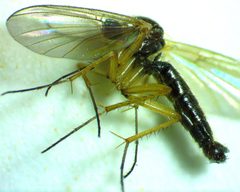
1Sciophila is a of fungus gnats in the Mycetophilidae, established by Meigen in 1818. These small flies are characterized by their association with fungal and shadowy environments. The genus includes both widespread Palaearctic and Neotropical species that have been intercepted as glasshouse contaminants. Species such as Sciophila holopaineni from Finnish Lapland and S. fractinervis from the Neotropics demonstrate the genus's broad geographic range and ecological diversity.
Pronunciation
How to pronounce Sciophila: //ˌsaɪ.oʊˈfaɪ.lə//
These audio files are automatically generated. While they are not always 100% accurate, they are a good starting point.
Images
Habitat
in this occupy diverse ranging from natural and Arctic environments to artificial glasshouse settings. Sciophila holopaineni inhabits shadowy river gulches in old-growth forests of eastern Lapland, while S. fractinervis has been intercepted in nurseries and glasshouses on potted plants.
Distribution
The has a broad distribution spanning the Palaearctic and Neotropical regions. Sciophila holopaineni is known from two locations in Finland and Russian Karelia. Sciophila fractinervis is native to the Neotropics (described from southern Brazil) and has been intercepted in Britain and the Netherlands. Other such as S. muglolutea and S. turkolutea occur in southeastern Turkey.
Diet
Larvae of at least some feed on fungal material. Sciophila fractinervis larvae feed on saprophytic fungal spores trapped in webs they construct on potting medium and plant bases. Fungi identified from larval webbing include Plectosphaerella species, Alternaria, Penicillium, and Mucor.
Life Cycle
In Sciophila fractinervis, larvae construct mucous webbing networks on potting medium surfaces and around plant bases, with pupae suspended in fine filamentous webbing in lower stems or leaf axils. Development from larva to takes approximately 10 days under incubation conditions.
Behavior
Larvae of S. fractinervis exhibit rapid retreat response to vibrations or -like movements. They produce scaffolding-like webs from labial gland secretions that serve multiple functions: aiding in dry locations, acting as a barrier against , and trapping fungal spores for feeding.
Ecological Role
Saprophagous and mycetophagous; larvae consume saprophytic fungal spores in both natural forest environments and glasshouse settings. No plant damage has been observed in glasshouse interceptions.
Human Relevance
Some have significance as indicators of quality and as glasshouse contaminants. Sciophila holopaineni was named after musician Tuomas Holopainen, raising public awareness of biodiversity. Sciophila fractinervis has been intercepted multiple times in British nurseries on imported ornamental and herb plants, though it causes no apparent damage.
Sources and further reading
- BugGuide
- Wikipedia
- iNaturalist taxon
- NCBI Taxonomy
- Catalogue of Life
- fungus gnat | Blog
- Diptera | Blog - Part 2
- biodiversity | Blog - Part 44
- Further interceptions of the Neotropical fungus gnat Sciophila fractinervis Edwards, 1940 (Diptera, Mycetophilidae) in Britain with comments and observations on its biology and spread
- Two new species of Sciophila Meigen (Diptera: Mycetophilidae) from Turkey, with a key to the Western Palaearctic species of the S. lutea Macquart group
- Figure 4 from: Deady RJ, Delaney MA, Jones E, Chandler PJ (2022) Further interceptions of the Neotropical fungus gnat Sciophila fractinervis Edwards, 1940 (Diptera, Mycetophilidae) in Britain with comments and observations on its biology and spread. Biodiversity Data Journal 10: e94812. https://doi.org/10.3897/BDJ.10.e94812
- Figure 2 from: Deady RJ, Delaney MA, Jones E, Chandler PJ (2022) Further interceptions of the Neotropical fungus gnat Sciophila fractinervis Edwards, 1940 (Diptera, Mycetophilidae) in Britain with comments and observations on its biology and spread. Biodiversity Data Journal 10: e94812. https://doi.org/10.3897/BDJ.10.e94812
- Figure 1 from: Deady RJ, Delaney MA, Jones E, Chandler PJ (2022) Further interceptions of the Neotropical fungus gnat Sciophila fractinervis Edwards, 1940 (Diptera, Mycetophilidae) in Britain with comments and observations on its biology and spread. Biodiversity Data Journal 10: e94812. https://doi.org/10.3897/BDJ.10.e94812
- Figure 6 from: Deady RJ, Delaney MA, Jones E, Chandler PJ (2022) Further interceptions of the Neotropical fungus gnat Sciophila fractinervis Edwards, 1940 (Diptera, Mycetophilidae) in Britain with comments and observations on its biology and spread. Biodiversity Data Journal 10: e94812. https://doi.org/10.3897/BDJ.10.e94812
- Figure 3 from: Deady RJ, Delaney MA, Jones E, Chandler PJ (2022) Further interceptions of the Neotropical fungus gnat Sciophila fractinervis Edwards, 1940 (Diptera, Mycetophilidae) in Britain with comments and observations on its biology and spread. Biodiversity Data Journal 10: e94812. https://doi.org/10.3897/BDJ.10.e94812
- Figure 5 from: Deady RJ, Delaney MA, Jones E, Chandler PJ (2022) Further interceptions of the Neotropical fungus gnat Sciophila fractinervis Edwards, 1940 (Diptera, Mycetophilidae) in Britain with comments and observations on its biology and spread. Biodiversity Data Journal 10: e94812. https://doi.org/10.3897/BDJ.10.e94812