
Macrocera
Meigen, 1803
predatory fungus gnats
Species Guides
4Macrocera is a of predatory fungus gnats in the Keroplatidae, containing at least 190 described . Species within this genus exhibit diverse : some inhabit caves with larvae that construct prey-capture webs, while others develop in decaying wood where larvae feed on fungal mycelia. The genus demonstrates considerable ecological plasticity across its members.
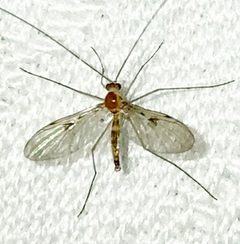
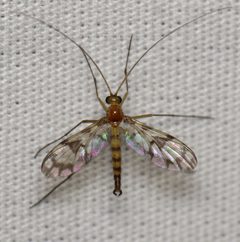
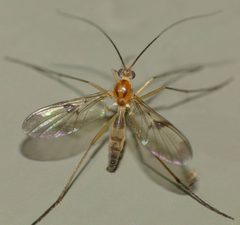
Pronunciation
How to pronounce Macrocera: /ˌmæk.roʊˈsɪə.rə/
These audio files are automatically generated. While they are not always 100% accurate, they are a good starting point.
Identification
Members of Macrocera can be distinguished from other Keroplatidae by their relatively large body size and elongated compared to related fungus gnat . Specific identification to level requires examination of wing venation patterns and male genitalia.
Images
Habitat
varies considerably among . Some species occur in caves, where larvae develop exclusively in the dark zone. Other species inhabit decaying wood in moist forest environments. At least one species has been documented in both forest and cave settings.
Distribution
Documented from caves in Oklahoma, Missouri, Kentucky, Tennessee, and West Virginia, USA; forests in New Hampshire and Massachusetts, USA. GBIF records indicate presence in Denmark, Norway, and Sweden. The is likely more widely distributed given its .
Seasonality
Seasonality appears variable among . Macrocera anglica shows development with in spring. Macrocera nobilis exhibits continuous, non-seasonal and development in cave environments.
Diet
Larvae of some are predatory, capturing insect prey (primarily other Diptera) using silken webs. Larvae of other species feed on fungal mycelia.
Life Cycle
includes , larval, pupal, and stages. Larval duration varies: 9-10 months in Macrocera nobilis; four instars reported in Macrocera anglica. Pupal stage lasts approximately 2 weeks in Macrocera nobilis.
Behavior
Larvae construct silken webs or tubes. In cave-dwelling , these webs are used for locomotion and prey capture. In wood-inhabiting species, silken structures provide protection during feeding on fungal substrates. are short-lived.
Ecological Role
Predatory function as of other insects in cave . Fungivorous species contribute to wood decomposition and nutrient cycling in forest .
Sources and further reading
- BugGuide
- Wikipedia
- GBIF taxonomy match
- iNaturalist taxon
- NCBI Taxonomy
- Catalogue of Life
- The Biology and Morphology of the Immature Stages of Macrocera Anglica Edwards
- LIFE HISTORY OF THE FUNGUS GNAT MACROCERA NOBILIS IN AMERICAN CAVES (DIPTERA: MYCETOPHILIDAE)
- Anthropogenic Disturbances: the Red Ghost Crab (Ocypode Macrocera) Is under Threat at Lalkakrar Char, Kuakata, Bangladesh
- First Report on Unlocking the Biochemical Wealth of the Ocypode Macrocera (Red Ghost Crabs): Multifunctional Biocompound Recovery from an Underexplored Coastal Resource
- Evaluation of Habitat off Red Ghost Crab <i>Ocypode macrocera</i> in Kanika Island, Bhadrak District, Odisha, India
- Coastal Tourism Induced Alterations in Red Ghost Crab (Ocypode macrocera) Burrow Distribution and Burrow Parameters in Dakshin Purushottampur Beach, West Bengal, India
- Red Ghost Crab Ocypode Macrocera (H. Milne Edwards, 1852) Population Dynamics Changes at Bay of Bengal Coast Line in Response to Construction of Digha Marine Drive and Tajpur Port: EIA Study by Rammohan College
- Conservation efforts mitigate effects of human disturbance on ghost crab (Ocypode macrocera) abundance and behavior on a sandy beach in Kuakata, Bangladesh
- Davimacrocera, a New Extant Genus of Keroplatidae, with Notes on the Fossil Genus Burmacrocera (Diptera).