
Rhopalomyia pomum
Gagné, 1975
Sponge Gall Midge
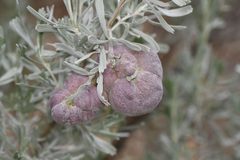
Rhopalomyia pomum, commonly known as the sponge gall midge, is a gall-forming insect in the Cecidomyiidae. The induces distinctive leaf galls on Great Basin sagebrush (Artemisia tridentata). It was described by Gagné in 1975 and is recognized as a valid species in current taxonomic databases.
Pronunciation
How to pronounce Rhopalomyia pomum: /roʊˌfæl.əˈmɪ.a ˈpoʊ.məm/
These audio files are automatically generated. While they are not always 100% accurate, they are a good starting point.
Identification
Identification relies on the distinctive galls produced on plants: spongy, irregular growths on leaves of Artemisia tridentata. are small, delicate flies typical of the Cecidomyiidae, with reduced wing venation and long, bead-like . Specific morphological characters for distinguishing R. pomum from require examination of male genitalia and antennal structure.
Images
Habitat
Associated with stands of Great Basin sagebrush (Artemisia tridentata), which grows in arid and semi-arid regions of western North America including sagebrush steppe, shrublands, and dry mountain slopes.
Distribution
Western North America, corresponding to the range of its plant Artemisia tridentata: primarily the Great Basin and adjacent regions of the United States including California, Nevada, Utah, Oregon, Idaho, Wyoming, and Colorado.
Diet
Larvae feed on plant tissue within the gall structure on Artemisia tridentata. feeding habits are unknown.
Host Associations
- Artemisia tridentata - gall inducerforms leaf galls
Behavior
Induces gall formation on plant leaves through larval feeding activity. The spongy gall tissue provides shelter and nutrition for developing larvae.
Ecological Role
As a gall inducer, modifies plant tissue architecture, potentially affecting leaf function and plant resource allocation. Serves as a food source for and other natural enemies that attack gall midge larvae.
Similar Taxa
- Rhopalomyia spp.Numerous also form galls on Artemisia ; differentiation requires detailed morphological examination of and gall characteristics.
- Other Cecidomyiidae on ArtemisiaMultiple gall midge utilize Artemisia as ; gall and location (leaf vs. stem vs. bud) help distinguish species.
More Details
Taxonomic Status
Catalogue of Life lists this name as a synonym, but GBIF and NCBI recognize it as an accepted valid . This discrepancy may reflect ongoing taxonomic revision in the Rhopalomyia, which contains many described species with complex synonymy.