
Mayetiola destructor
(Say, 1817)
Hessian fly, barley midge
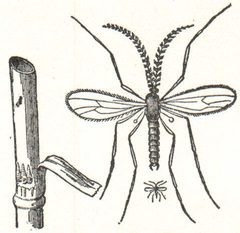
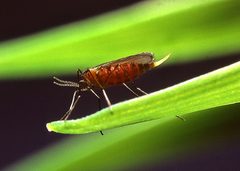
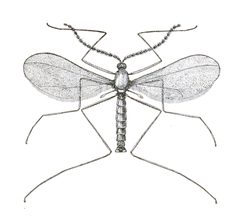
The (Mayetiola destructor) is a major pest of wheat and other cereal crops. are small, mosquito-like flies with dark wings, black , and dark red . Females deposit in clusters on wheat leaf surfaces; larvae feed on stem tissue, causing stunting, lodging, and reduced grain yield. Unlike most Cecidomyiidae, this does not form galls. Native to Asia, it has spread globally and was one of the earliest documented in North America, first reported in 1779.
Pronunciation
How to pronounce Mayetiola destructor: //maɪˈɛti.oʊlə dɪˈstrʌktər//
These audio files are automatically generated. While they are not always 100% accurate, they are a good starting point.
Identification
can be distinguished from other small flies by the combination of dark wings, black , and dark red . Larvae are identified by their location under leaf at the plant crown or nodes, white color with green stripe, and the distinctive "flaxseed" . Unlike most Cecidomyiidae (gall midges), this does not induce gall formation. Molecular identification may be required to distinguish from related Mayetiola species.
Images
Habitat
Agricultural fields and areas with cultivated or volunteer wheat, barley, rye, and related grasses. Also found on wild grass including little barley, goatgrass, quackgrass, timothy, and western wheatgrass.
Distribution
Native to Asia (Middle East region); introduced to Europe and North America. Present across major wheat-producing regions worldwide including: North America (USA, Canada), Europe (widespread), North Africa (Algeria, Morocco, Tunisia), Middle East (Iraq, Israel, Syria, Turkey), New Zealand, and parts of the former USSR. In the USA, occurs throughout wheat-growing states from the Great Plains to the East Coast.
Seasonality
Activity varies by latitude. In northern regions (Kansas and northward), completes two annually. In southern states, completes three to six generations. emerge in late summer and early fall in Texas, with -laying continuing into December during warm periods. Spring occur when larvae resume feeding. Summer is passed as larvae within .
Diet
Larvae feed on stem tissue of wheat and related grasses, sucking plant juices from the crown of young plants or from nodes on jointed wheat. do not feed.
Host Associations
- Triticum aestivum - primary wheat
- Hordeum vulgare - barley
- Secale cereale - rye
- Triticale -
- Triticum dicoccum - emmer
- Triticum spelta - spelt
- Agropyrum spp. - wheatgrasses
- Hordeum pusillum - little barley
- Aegilops spp. - goatgrass
- Elymus repens - quackgrass
- Phleum pratense - timothy
- Pascopyrum smithii - western wheatgrass
Life Cycle
are deposited in clusters of 5-12 in grooves on upper leaf surfaces. Larvae hatch and move down leaf grooves to feed under leaf at the crown or nodes. Larval development includes two instars lasting 2-3 weeks. Mature larvae form a rigid, dark brown ("flaxseed" stage) within which they overwinter as , fully developed larvae. emerge from puparia, live 1-4 days, mate, and females lay approximately 200 eggs (average) before dying.
Behavior
Females prefer to lay on younger plants and leaves. Larvae feed concealed under leaf , making them difficult to target with foliar . During the day, larvae remain hidden; activity not documented. are short-lived and do not disperse far from sites. larvae in can survive in for up to two years.
Ecological Role
Herbivore and agricultural pest. Serves as for including Platygaster hiemalis. influenced by natural enemies, , and cultural practices.
Human Relevance
Major economic pest of wheat causing significant yield losses globally. Damage includes stunted tillers, reduced forage production, winterkill of infested plants, stem lodging, and reduced grain quality and quantity. : 5-8% infested stems in fall, 20% in spring. Management relies on wheat varieties, delayed planting, destruction of volunteer wheat, crop , and . Historical significance as one of the earliest documented in North America (1779), purportedly introduced in straw bedding of Hessian troops during the American Revolution.
Similar Taxa
- Other Cecidomyiidae speciesMost gall midges in this induce gall formation on plants; Mayetiola destructor is unique in not forming galls despite being in this family
- Mayetiola speciesRelated may occur on grasses; molecular or detailed morphological analysis required for definitive identification
- Aphid pests of wheat, , and other cereal aphids cause similar stunting and discoloration but are Hemiptera with different and visible cornicles
More Details
Chromosome elimination
Unusual developmental feature: during early embryogenesis, elimination occurs from presumptive somatic . After the fourth division, 14 nuclei in the main divide and lose approximately 32 chromosomes (retaining only 8), while 2 nuclei associated with polar retain the full ~40 chromosome complement and become germ-line . This process is controlled by polar granules, which prevent germ-cell nuclei from dividing during the fifth cleavage division. Experimental disruption of this process produces sterile .
Biotypes and host resistance
exist as distinct that vary in ability to survive on wheat varieties with specific resistance genes. Continuous planting of varieties selects for virulent biotypes that overcome resistance. Texas A&M AgriLife Extension publishes wheat variety trial results including Hessian fly resistance ratings.
IPM integration
Effective management combines multiple tactics: varieties, delayed planting, volunteer wheat destruction, crop , residue burial, and by . Parasitoids are particularly valuable when combined with resistant varieties, as they attack larvae that survive to pupal stage on resistant plants, slowing resistance development.
Sources and further reading
- BugGuide
- GBIF taxonomy match
- iNaturalist taxon
- NCBI Taxonomy
- Catalogue of Life
- Congratulations, UC Davis Linnaean Games Team: National Champs! | Bug Squad
- These Entomologists Are a Powerhouse of a Team | Bug Squad
- Aboveground Pests - AgriLife Extension Entomology
- Managing Insect and Mite Pests of Texas Small Grains - AgriLife Extension Entomology
- Hessian Fly: New Guide Details Wheat Pest Management
- How One Early-Career Entomologist's Path Led Him to the ESA Governing Board
- Mayetiola destructor . [Distribution map].
- Mayetiola destructor . [Distribution map].
- Experiments on chromosome elimination in the gall midge, Mayetiola destructor
- Parasitism of Mayetiola destructor (Diptera: Cecidomyiidae) by Platygaster hiemalis (Hymenoptera: Platygasteridae) on Hessian Fly-Resistant Wheats2