
Celticecis cupiformis
Gagné, 2013
hackberry barrel gall midge
Celticecis cupiformis is a gall midge described by Gagné in 2013. It induces distinctive barrel-shaped galls on hackberry trees (Celtis species). The species belongs to the Celticecis, which comprises gall-forming specialized on Celtis . The "hackberry barrel gall midge" reflects both its host association and gall .
Pronunciation
How to pronounce Celticecis cupiformis: //ˌkɛl.tɪˈseɪ.sɪs ˌkjuː.pɪˈfɔːr.mɪs//
These audio files are automatically generated. While they are not always 100% accurate, they are a good starting point.
Identification
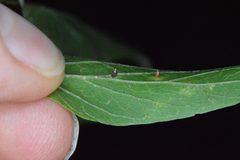
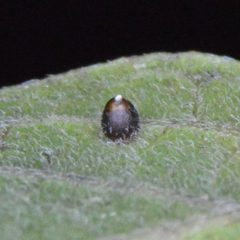
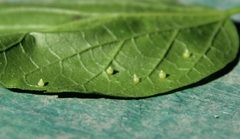
Identification relies primarily on gall : barrel-shaped (cupiform) galls on hackberry leaves or stems, with the epithet "cupiformis" referring to this cup-like shape. are small, delicate flies typical of Cecidomyiidae, with reduced wing venation and bead-like . Definitive identification requires examination of adult specimens by a ; gall morphology alone may not distinguish it from congeneric species on Celtis.
Images
Habitat
Associated with hackberry trees (Celtis ), occurring in where these trees grow, including riparian zones, woodlands, and urban plantings.
Distribution
Distribution corresponds to the range of its Celtis in North America; specific range limits are not well documented.
Seasonality
Gall formation and patterns are tied to tree ; precise timing is not documented in available sources.
Diet
Larvae feed on plant tissue within the gall structure induced on Celtis . do not feed.
Host Associations
- Celtis - plantPrimary ; induces galls on hackberry .
Life Cycle
Incomplete details are available. As with other Cecidomyiidae, development likely includes , larval, pupal, and stages, with larval development occurring within the gall tissue. Specific details on voltinism and stage are not documented.
Behavior
Induces gall formation on hackberry plants through chemical manipulation of tissue. Larvae develop within the protective gall structure.
Ecological Role
Acts as a gall-forming herbivore on Celtis . Galls may provide microhabitat for other organisms; specific ecological relationships are not documented.
Human Relevance
Minor relevance; gall formation may be noticeable on ornamental hackberry trees but does not appear to cause significant economic damage. Of interest to entomologists studying gall-forming insects and their associations.
Similar Taxa
- Celticecis speciesCongeneric also form galls on Celtis; differentiation requires gall details and specimen examination.
- Other hackberry gall midgesMultiple Cecidomyiidae induce galls on Celtis; accurate identification requires knowledge of gall and .
More Details
Etymology
The specific epithet "cupiformis" derives from Latin, referring to the cup- or barrel-shaped gall .
Taxonomic history
Described by Raymond Gagné in 2013, a leading authority on Cecidomyiidae .