
Thecodiplosis
Kieffer, 1895
Species Guides
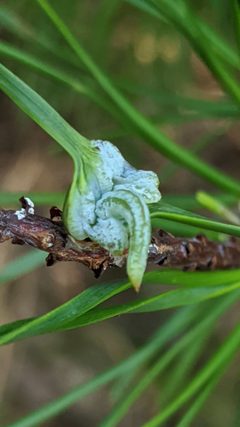
1Thecodiplosis is a of gall midges (Diptera: Cecidomyiidae) comprising approximately six described . Species in this genus induce galls on pine needles, with documented including Pinus densiflora, P. thunbergii, P. resinosa, and other Pinus species. The genus has become economically significant as an pest in some regions, particularly Thecodiplosis japonensis, which has established in China since 2016.
Pronunciation
How to pronounce Thecodiplosis: //ˌθɛkoʊdɪˈploʊsɪs//
These audio files are automatically generated. While they are not always 100% accurate, they are a good starting point.
Identification
Gall midges in this are distinguished from other Cecidomyiidae by their association with pine needle galls. Specific morphological characters for genus-level identification require examination of specimens, including details of antennal structure and genitalia. -level identification within Thecodiplosis relies on subtle differences in wing venation, palp structure, and male genital ; accurate determination typically requires reference to original species descriptions.
Images
Habitat
Pine forests and plantations, specifically associated with needles of Pinus . Documented plants include Japanese red pine (Pinus densiflora), Japanese black pine (P. thunbergii), red pine (P. resinosa), and masson pine (P. massoniana).
Distribution
Native to eastern Asia, with confirmed records from Japan (Honshu, Kyushu, Shikoku, Ryukyu Archipelago), Korea (Democratic People's Republic and Republic), and China (Fujian Province). Thecodiplosis japonensis has expanded its range through invasion into additional areas of China. European records (Denmark, Norway, Sweden in GBIF) likely represent introduced or data artifacts requiring verification.
Seasonality
Activity patterns vary by and climate. Thecodiplosis japonensis exhibits in spring, with larval development in galls during summer and as mature larvae in soil. Multiple per year have been documented in some .
Host Associations
- Pinus densiflora - Japanese red pine; primary native of T. japonensis
- Pinus thunbergii - Japanese black pine; primary native of T. japonensis
- Pinus resinosa - Red pine; of T. piniresinosae and T. brachynteroides
- Pinus massoniana - Masson pine; documented of T. japonensis in invaded range
- Pinus luchuensis - Documented of T. japonensis
Life Cycle
are deposited on pine needles. Larvae induce gall formation on needles, developing within these structures. Mature larvae exit galls and drop to the soil to overwinter. occurs in soil. The period involves utilization of lipid reserves for metabolic maintenance, with activities for synthesis decreasing mid-winter and increasing toward spring .
Behavior
exhibit chemosensory-mediated for location and mate finding, with 67 chemosensory genes identified in T. japonensis including odorant-binding proteins, chemosensory proteins, odorant receptors, receptors, and ionotropic receptors. Larval distribution patterns show both within and among host trees, with -dependent mortality factors influencing .
Ecological Role
As gall-formers, in this act as phytophagous herbivores that modify plant tissue structure. They serve as hosts for specialized , including platygastrid (Platygaster matsutama, Inostemma seoulis) that function as -larval parasitoids. The host-parasitoid system exhibits temporal structuring and competitive interactions among parasitoid species. Gall formation alters endophytic fungal communities in pine needles, facilitating increased and hastened by certain fungi compared to healthy needle tissue.
Human Relevance
Several are significant forest pests. Thecodiplosis japonensis has caused serious damage in invaded regions of China since 2016, prompting research into attractant-based management targeting odorant-binding proteins. The has been subject to studies, with investigations supporting multi-species introductions for suppression. Thecodiplosis piniresinosae and related species cause needle damage and discoloration in North American pine plantations.
Similar Taxa
- ContariniaBoth are of Cecidomyiidae that form galls on coniferous ; distinguished by gall , host specificity patterns, and morphological characters including antennal bead structure and wing venation details
- ResseliellaAnother of pine-feeding gall midges; separation requires examination of larval gall structure and genitalia
More Details
Chemosensory Biology
Transcriptomic analysis of T. japonensis has identified 26 odorant-binding proteins (OBPs), 2 chemosensory proteins (CSPs), 17 odorant receptors (ORs), 3 proteins (SNMPs), 6 receptors (GRs), and 13 ionotropic receptors (IRs). Sixteen OBPs show antenna-biased expression, with TjapORco and TjapOR5 highly expressed in unmated of both sexes, suggesting roles in mate and location.
Invasion Dynamics
The 25-year invasion history of T. japonensis demonstrates how - structure develops through sequential establishment of parasitoid , with phenological differences and incomplete competitive superiority enabling parasitoid coexistence and potentially enhancing overall efficacy.
Sources and further reading
- BugGuide
- Wikipedia
- GBIF taxonomy match
- iNaturalist taxon
- NCBI Taxonomy
- Catalogue of Life
- Thecodiplosis japonensis . [Distribution map].
- Parasites Associated with the Red-Pine Needle Midge Thecodiplosis piniresinosae Kearby1
- A New Species of Thecodiplosis (Diptera: Cecidomyiidae) on Red Pine in Wisconsin
- Parasitic Hymenoptera associated with Thecodiplosis brachyntera (Diptera: Cecidomyiidae) on the genus Pinus (Pinaceae) in the Czech Republic
- Identification and expression profile analysis of chemosensory genes in pine needle gall midge, Thecodiplosis japonensis (Diptera: Cecidomyiidae)
- Ecology of host‐parasitoid community in the pine needle gall midge, Thecodiplosis japonensis Uchida et Inouye (Diptera, Cecidomyiidae)
- Differential thermal biology may explain the coexistence of Platygaster matsutama and Inostemma seoulis (Hymenoptera: Platygastridae) attacking Thecodiplosis japonensis (Diptera: Cecidomyiidae)
- Endophytic fungi associated with healthy pine needles and needles infested by the pine needle gall midge, Thecodiplosis japonensis
- Studies on the distribution pattern of the pine needle gall midge, Thecodiplosis japonensisUchida etInouye (Diptera: Cecidomyiidae) in a pine forest
- ECOLOGY OF PLA TYGASTER MA TSUTAMA AND INOSTEMMA SEOULIS (HYMENOPTERA : PLATYGASTRIDAE), EGG-LARVAL PARASITES OF THE PINE NEEDLE GALL MIDGE, THECODIPLOSIS JAPONENSIS (DIPTERA, CECIDOMYIIDAE)
- ENZYMES OF FATTY ACID METABOLISM IN OVERWINTERING MATURE LARVAE OF THE PINE NEEDLE GALL MIDGE, THECODIPLOSIS JAPONENSIS*
- Structural dynamics in the host-parasitoid system of the pine needle gall midge (Thecodiplosis japonensis) during invasion