
Schizomyia impatientis
(Osten Sacken, 1862)
Jewelweed Gall Midge
Schizomyia impatientis is a gall midge in the Cecidomyiidae. The induces characteristic galls on jewelweeds (Impatiens species) in eastern North America. It was first described by Carl Robert Osten-Sacken in 1862. The Jewelweed Gall Midge reflects its specialized association with these plants.
Pronunciation
How to pronounce Schizomyia impatientis: //ˌskɪzoʊˈmaɪə ɪmˌpeɪʃənˈtɪs//
These audio files are automatically generated. While they are not always 100% accurate, they are a good starting point.
Identification
Identified by the presence of its characteristic galls on jewelweed (Impatiens capensis and I. pallida). The galls are distinct from those of other Schizomyia by host specificity and gall . identification requires microscopic examination of antennal structure and genitalia; species-level determination is difficult without associated host or gall material.
Images
Appearance
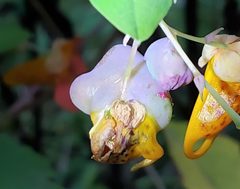
are minute flies typical of gall midges, with reduced wing venation and long, bead-like . Larvae are small, legless maggots that develop within plant galls. The galls themselves appear as swollen, distorted growths on jewelweed stems, leaves, or flowers.
Habitat
Associated with moist, shaded where jewelweeds grow: stream banks, woodland edges, wetlands, and disturbed moist soils. The itself occupies the interior of plant galls during larval development.
Distribution
Eastern North America; documented from Vermont and other parts of the United States. Range corresponds to that of its plants Impatiens capensis and I. pallida.
Seasonality
Activity period corresponds with jewelweed growing season; likely emerge in spring to early summer when plants are actively growing. Exact not well documented.
Diet
Larvae feed on plant tissue within galls, inducing and consuming gall tissue. do not feed or have reduced mouthparts.
Host Associations
- Impatiens capensis - spotted jewelweed, primary
- Impatiens pallida - pale jewelweed, secondary
Life Cycle
Complete with , larva, pupa, and stages. Females lay eggs on jewelweed tissue. Larvae induce gall formation and feed internally. occurs within the gall or in soil. Adults are short-lived and do not feed. Specific timing of not well documented.
Behavior
Larvae are sedentary, remaining within galls throughout development. are weak fliers with limited capacity. Mating and oviposition not described in detail.
Ecological Role
Acts as a herbivore on jewelweeds. Gall formation may affect plant growth and . Serves as prey for and other natural enemies. Provides microhabitat for and other organisms within galls.
Human Relevance
Minor significance; occasionally noticed by naturalists and botanists studying jewelweeds. No economic importance to agriculture or forestry. Used in ecological studies of plant-insect interactions and gall .
Similar Taxa
- Other Schizomyia speciesSame but attack different plants; S. impatientis distinguished by exclusive association with Impatiens
- Other Cecidomyiidae on ImpatiensDifferent gall and location on plant; precise identification requires rearing or dissection
More Details
Gall morphology
Galls induced by S. impatientis are typically irregular swellings on stems, leaf petioles, or flower buds. The specific gall form varies with location on plant and developmental stage of tissue attacked.
Taxonomic history
Originally described by Osten-Sacken in 1862, this has remained in the Schizomyia without significant taxonomic revision. The species epithet 'impatientis' derives from its genus Impatiens.