
Asphondylia antennariae
(Wheeler, 1889)
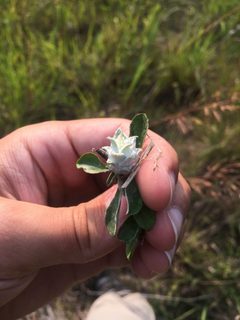
Asphondylia antennariae is a gall midge in the Cecidomyiidae. The larvae induce galls on the buds of Antennaria plantaginifolia, a plantain-leaved pussytoes. First described by William Morton Wheeler in 1889, this has been documented in Wisconsin and Maine, though its plant ranges widely across eastern North America.
Pronunciation
How to pronounce Asphondylia antennariae: /æs.fɒnˈdɪl.iə ænˌtɛnˈɛəriˌaɪ/
These audio files are automatically generated. While they are not always 100% accurate, they are a good starting point.
Identification
Distinguished from other Asphondylia by its specific association with Antennaria plantaginifolia bud galls. The galls themselves are the primary field indicator—abnormal swellings or distortions on the buds of this plant. Similar gall midges on other Antennaria species or related Asteraceae would require rearing for definitive identification.
Images
Habitat
Associated with open, dry where Antennaria plantaginifolia grows, including prairies, meadows, and rocky or sandy soils. The plant itself colonizes disturbed and open ground.
Distribution
Documented from Wisconsin and Maine in the United States. The plant Antennaria plantaginifolia is widespread in eastern North America, suggesting potential broader distribution of the .
Seasonality
emerge in spring when Antennaria plantaginifolia is in bloom and producing new buds. Larval development occurs through the growing season, with winter or slow development in the gall. and adult complete the cycle the following spring.
Diet
Larva feeds on tissue of developing Antennaria plantaginifolia buds, inducing gall formation. The gall provides both nutrition and shelter.
Host Associations
- Antennaria plantaginifolia - gall inductionSpecific ; larvae induce galls on buds
Life Cycle
laid in developing bud of plant in spring. Larva hatches and feeds within bud tissue, inducing gall formation. Larva develops through summer, in gall. occurs in spring; emerges to mate and oviposit into new buds.
Ecological Role
Acts as a gall inducer, manipulating plant tissue to create a protected feeding environment. The galls represent a form of plant that may affect bud development and flowering in the host.
Similar Taxa
- Asphondylia ilicicolaAnother Asphondylia inducing fruit galls on Ilex opaca; distinguished by plant (holly vs. pussytoes) and gall location (berry vs. bud)
- Other Asphondylia spp.Numerous induce galls on diverse plants; identification requires host association and often morphological examination
More Details
Gall biology
Like other Asphondylia , the mechanism of gall induction involves salivary secretions that manipulate plant , causing localized tissue proliferation. The specific chemistry remains unknown.
Taxonomic history
Described by William Morton Wheeler in 1889, making it among the earlier documented North American gall midges. The specific epithet antennariae directly references its .
Sources and further reading
- BugGuide
- Wikipedia
- GBIF taxonomy match
- iNaturalist taxon
- Catalogue of Life
- Deck the halls with boughs of holly adorned with cheery red and green berries! Green is good for holly berry midge, Asphondylia ilicicola — Bug of the Week
- Deck the halls with boughs of holly…and the Native holly leafminer, 'Phytomyza ilicicola', and Holly berry midge, 'Asphondylia ilicicola' — Bug of the Week
- Green is good - Holly berry midge, Asphondylia ilicicola — Bug of the Week
- Green is good for holly berry midge, Asphondylia ilicicola — Bug of the Week
- The Insects Behind the Weird Growths on Plants
- Archive — Bug of the Week