
Lepidophora lutea
Painter, 1962
Hunchbacked Bee Fly
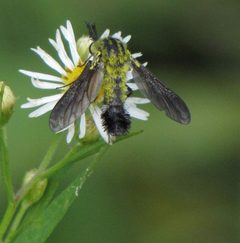
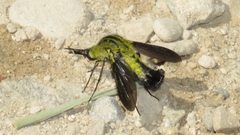
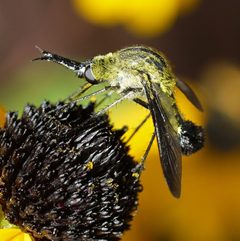
Lepidophora lutea is a of bee fly in the Bombyliidae, commonly known as the Hunchbacked Bee Fly. It is distinguished from its L. lepidocera by having pale on both the 4th and 5th abdominal segments rather than only the 5th. The species exhibits a distinctive hunch-backed body shape shared with other members of its . have been observed visiting flowers for nectar.
Pronunciation
How to pronounce Lepidophora lutea: /ˌlɛ.pɪˈdɒ.fə.rə ˈluː.ti.ə/
These audio files are automatically generated. While they are not always 100% accurate, they are a good starting point.
Identification
Distinguished from the southern Lepidophora lepidocera by having pale on both the 4th and 5th abdominal segments; L. lepidocera has pale scales restricted to the 5th segment. Shares the distinctive hunch-backed body shape characteristic of the .
Images
Distribution
Ontario, Canada and the eastern United States, from Maine and Florida west to Minnesota and Louisiana; also recorded in Vermont.
Life Cycle
Behavior
have been observed taking nectar from flowers.
Similar Taxa
- Lepidophora lepidoceraSimilar hunch-backed body shape; distinguished by L. lutea having pale on both 4th and 5th abdominal segments versus only the 5th in L. lepidocera; L. lepidocera occurs in the southern United States