
Hemipenthes celeris
(Wiedemann, 1828)
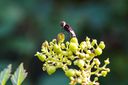
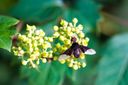
Hemipenthes celeris is a of bee fly in the Bombyliidae. It was first described by Wiedemann in 1828. A 2009 taxonomic review synonymized three previously recognized species names under H. celeris, establishing it as the valid name for this in North America. Like other members of the Hemipenthes, its larvae are hyper- of other parasitic insects.
Pronunciation
How to pronounce Hemipenthes celeris: //ˌhɛməˈpɛnθiːz ˈsɛlərɪs//
These audio files are automatically generated. While they are not always 100% accurate, they are a good starting point.
Identification
Identification of H. celeris requires examination of morphological characters distinguishing it from other Hemipenthes . The 2009 taxonomic review by Evenhuis provides the authoritative framework for distinguishing this species from its former synonyms H. floridiana, H. pima, and H. sagata. Specific diagnostic characters are not provided in available sources.
Images
Distribution
North America. The synonym H. pima was described from Arizona, suggesting occurrence in the southwestern United States. The synonym H. floridiana suggests occurrence in the southeastern United States.
Seasonality
Spring has been noted as a season when bee flies in general are active and visible.
Life Cycle
Larvae of Hemipenthes are hyper-, parasitizing the larvae of ichneumon wasps, tachinid flies, and other insects that are themselves parasites of caterpillars of butterflies and moths.
Ecological Role
As hyper-, larvae contribute to of primary . The ecological significance of this three-tiered parasitic relationship in dynamics has not been quantified.
Similar Taxa
- Hemipenthes eumenesPreviously considered distinct but now synonymized under H. seminigra; shares -level hyper-parasitic .
- Hemipenthes morioPreviously considered to have Holarctic distribution including North America, but now recognized as Palearctic only.
More Details
Taxonomic History
The 2009 review by Evenhuis in Zootaxa clarified the of North American Hemipenthes, establishing H. celeris as the senior valid name and recognizing three new synonyms.