
Stichopogon
Loew, 1847
Species Guides
7- Stichopogon abdominalis
- Stichopogon argenteus(Silvery Pirate)
- Stichopogon catulus
- Stichopogon colei
- Stichopogon fragilis
- Stichopogon trifasciatus(Three-banded Robber Fly)
- Stichopogon venturiensis
Stichopogon is a of small robber flies ( Asilidae) in the Dasypogoninae, comprising at least 100 described worldwide. These diminutive predatory flies are most diverse in arid and semi-arid regions, with strong representation in North America, the Neotropics, North Africa, and the Middle East. The genus is ecologically associated with open, barren —particularly sandy, gravelly, or rocky substrates near water or in dry washes—where they perch low to the ground and ambush small prey.
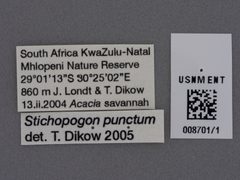
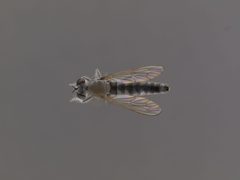
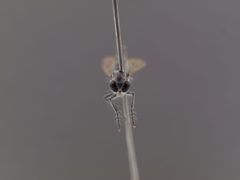
Pronunciation
How to pronounce Stichopogon: /ˌstɪk.hoʊˈpoʊ.ɡɒn/
These audio files are automatically generated. While they are not always 100% accurate, they are a good starting point.
Identification
Distinguished from other small Asilidae by combination of small size (under 15 mm), preference for barren ground , and characteristic abdominal color patterns. Separated from similar in Dasypogoninae by details of wing venation, male terminalia, and facial mystax (beard) structure; precise identification requires examination of genitalic characters. In North America, S. trifasciatus is the most widespread and easily recognized due to its three-banded and silvery coloration. Other small asilid genera (e.g., certain Laphria or Holcocephala) typically occur in vegetated habitats and show different perching .
Images
Habitat
Open, barren substrates with sparse vegetation: sandy prairies, sand barrens, gravelly riverbanks, rocky beaches, dry washes, and unpaved roads. Strongly associated with loose, sandy or gravelly soils where elevated perches are limited to low objects or bare ground itself. Often found near watercourses but also in arid areas well away from permanent water. Avoids dense vegetation and closed- .
Distribution
Widespread across multiple continents: North America (southern Canada to Central America), South America, North Africa, the Middle East, and Central Asia. In North America, occurs coast to coast with highest diversity in western and southwestern regions. Egyptian fauna includes nine recognized . Disjunct occur in specialized sand prairie in the southeastern United States.
Seasonality
activity generally concentrated in spring and fall in temperate regions, with reduced activity during midsummer heat. In subtropical and tropical areas, likely active during cooler dry seasons. Specific varies by and locality; S. trifasciatus observed active from early spring through autumn in Missouri sand prairies.
Diet
are predatory, feeding primarily on small arthropods. Documented prey includes small flies (Diptera, comprising approximately 85% of diet in one study), true bugs (Hemiptera, ~10%), and small spiders (Araneae). Prey is captured on the ground or from low perches rather than intercepted in . Prey size is limited by 's small stature.
Life Cycle
details remain poorly documented. Larval stages presumably subterranean or within soil/substrate, as is typical for Asilidae. Courtship observed in S. trifasciatus: male hovers before female with legs dangling and waving, then pounces to copulate. No detailed descriptions of deposition, larval development, or available for the .
Behavior
are sit-and-wait , perching on or very near bare ground and making short to capture prey. When disturbed, individuals take flight for short distances before alighting again—a reminiscent of tiger beetles (Cicindelinae). Does not engage in aerial hawking of flying insects. Males perform hovering . Generally solitary, with no social behavior documented.
Ecological Role
of small ground-dwelling arthropods in open, early-successional or disturbance-maintained . Likely contributes to regulation of small fly in sandy and gravelly . Serves as prey for larger predatory insects, spiders, and insectivorous vertebrates. Presence indicates intact, minimally vegetated sand or gravel habitats.
Human Relevance
Non-pest; provides beneficial service as of small flies including potential nuisance . No documented medical or economic importance. Occasionally encountered by entomologists and naturalists in sandy ; S. trifasciatus is among the most frequently photographed and observed species due to its distinctive appearance and accessible habitats.
Similar Taxa
- Cicindelinae (tiger beetles)Share similar preference (barren sandy/gravelly ground), low perching/standing , and short- escape response when disturbed; distinguished by beetles having hardened forewings (), thread-like , and running rather than flying predatory attacks.
- Other small Asilidae (e.g., Holcocephala, certain Laphria)Overlap in size and general body plan; distinguished by preferences (vegetated vs. barren ground), perching height, abdominal color patterns, and details of wing venation visible with magnification.
More Details
Taxonomic complexity
The exhibits substantial -level diversity with at least 100 described species globally, but many remain poorly known. Recent revisions (e.g., Barnes 2010, 2013 for North America) have synonymized previously recognized species based on morphological variation, such as the merger of S. salinus with S. trifasciatus. Accurate species identification often requires examination of male genitalia and geographic context.
Conservation context
Several have highly localized distributions restricted to imperiled sand prairie . In Missouri, of S. trifasciatus and potentially other species are associated with critically imperiled sand prairie remnants in the Southeast Lowlands, where habitat destruction threatens persistence.