
Stichopogon trifasciatus
(Say, 1823)
Three-banded Robber Fly
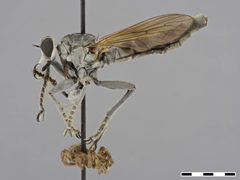
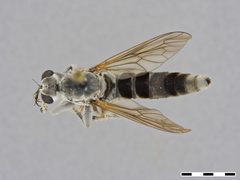
Stichopogon trifasciatus, commonly known as the three-banded robber fly, is a small predatory fly in the Asilidae. measure 10–15 mm and are distinguished by three alternating light and dark bands on the , a bright silvery or blue-gray body, and a preference for barren, sandy or gravelly near water. The occurs throughout North America from southern Canada to Central America, and south into the Neotropics. Formerly considered a separate species, S. salinus from the western Rocky Mountain region was synonymized with S. trifasciatus in 2010.

Pronunciation
How to pronounce Stichopogon trifasciatus: //ˌstɪk.oʊˈpoʊ.ɡən ˌtraɪ.fæʃ.iˈeɪ.təs//
These audio files are automatically generated. While they are not always 100% accurate, they are a good starting point.
Identification
The three-banded abdominal pattern and bright silvery/blue-gray body coloration distinguish this from other North American Stichopogon. The former S. salinus, now synonymized, showed variation in banding intensity but is not considered distinct. Among other small asilids, the combination of distinct abdominal banding and silvery coloration is diagnostic. Some individuals may show variable banding intensity, which previously led to confusion with S. salinus.
Images
Appearance
Small robber fly, 10–15 mm in length. Body bright silvery to blue-gray. with three distinct broad bands of alternating light and dark coloration, the source of both the and specific epithet. Body relatively slender compared to larger asilid . large, typical of predatory flies.
Habitat
Barren, sandy or gravelly areas, often near water. Rocky edges of rivers and streams. Rugged unpaved roads and similar open, sparsely vegetated surfaces. with elevated perches close to ground level.
Distribution
North America from southern Canada through the United States to Central America, and south into the Neotropics. Coast-to-coast distribution in North America. Occurs wherever suitable barren, sandy or gravelly near water are found.
Diet
Life Cycle
details remain largely unknown. Larval undescribed. Courtship observed: male hovers back and forth before female with legs hanging and waving, then pounces to attempt copulation.
Behavior
Perches close to ground on elevated substrates when available. When startled, takes short before alighting again, reminiscent of tiger beetles. Attacks prey crawling on ground by swooping down and stabbing with stout beak. Courtship involves male hovering display followed by pouncing copulation attempt.
Ecological Role
of small flying and crawling insects, including potential pest . Contributes to regulation of dipteran and hemipteran in sandy and gravelly .
Human Relevance
Beneficial that feeds on other small flies, including some that may bite or annoy humans. Not a pest or nuisance . Presence indicates healthy, open sandy or gravelly .
Similar Taxa
- Stichopogon salinusFormerly considered a separate based on western Rocky Mountain distribution and variable abdominal banding, but synonymized with S. trifasciatus by Barnes (2010)
- Other Stichopogon speciesNine other North American in ; S. trifasciatus most widespread and easily recognized by distinct three-banded pattern
- Other small AsilidaeDistinguished by combination of small size, silvery/blue-gray coloration, and three-banded abdominal pattern
More Details
Taxonomic History
Stichopogon salinus, described from the western edge of the Rockies (Idaho to northern Arizona), was synonymized with S. trifasciatus by Jeffrey K. Barnes in 2010, representing variation within the rather than distinct taxonomic status.
Etymology
Specific epithet 'trifasciatus' refers directly to the three bands on the ; 'Three-banded Robber Fly' translates this characteristic.