
Lasiopogon gabrieli
Cole & Wilcox, 1938
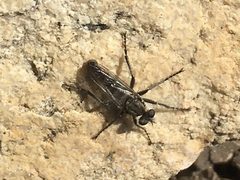
Lasiopogon gabrieli is a of robber fly (Diptera: Asilidae) in the bivittatus section, first described by Cole & Wilcox in 1938. It belongs to a of predatory flies found in western North America. The species was validated in a 2020 molecular phylogenetic revision of Nearctic Lasiopogon. Very few observations exist in public databases.
Pronunciation
How to pronounce Lasiopogon gabrieli: //ˌlæsioʊˈpoʊɡɒn ɡəˈbraɪli//
These audio files are automatically generated. While they are not always 100% accurate, they are a good starting point.
Identification
Members of the bivittatus section can be distinguished from other Lasiopogon sections by morphological characters detailed in taxonomic keys. For -level identification within the section, reference to the original description (Cole & Wilcox 1938) and the 2020 revision key to western Nearctic is required.
Images
Distribution
Western Nearctic region. Specific locality data not provided in available sources.
Ecological Role
As a member of Asilidae, functions as an aerial of other insects, though specific prey records for this are not documented in available sources.
Similar Taxa
- Other Lasiopogon species in bivittatus section13 in this section share morphological similarities requiring detailed key-based identification; L. gabrieli distinguished by characters in Cole & Wilcox 1938 original description
- Lasiopogon species in opaculus and cinereus sectionsDifferent sections of distinguished by wing venation, genitalia, and other morphological characters per Cannings 2002 classification system
More Details
Taxonomic history
Originally described in 1938; retained as valid in 2020 revision based on molecular (COI, AATS, PEPCK, Wg loci) and morphological reassessment
Etymology
epithet 'gabrieli' named after an individual; not to be confused with the trapdoor spider Ummidia gabrieli (Araneae), also named after Peter Gabriel in 2021
Sources and further reading
- BugGuide
- Wikipedia
- GBIF taxonomy match
- iNaturalist taxon
- NCBI Taxonomy
- Catalogue of Life
- Trapdoor spiders named after Neil Gaiman, Peter Gabriel and Brandi Carlile among 33 new to science species | Blog
- Molecular phylogeny of the genus Lasiopogon (Diptera: Asilidae) and a taxonomic revision of the bivittatus section