
Lasiopogon
Loew, 1847
Sandpirates
Species Guides
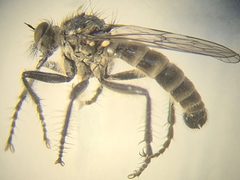
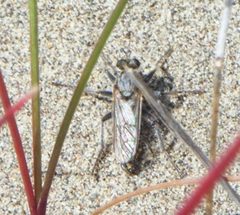
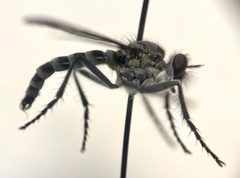
60Lasiopogon is a of robber flies (Asilidae) containing at least 80 described , commonly known as sandpirates. The genus has a predominantly Nearctic distribution with additional Palearctic representatives, including species in the mountains of Western and Central Europe. Recent taxonomic revisions have significantly expanded the known diversity, particularly through the description of 13 new species in the western Nearctic bivittatus section. Species-level identification relies heavily on male genitalic characters.
Pronunciation
How to pronounce Lasiopogon: //læˈsaɪəpəˌɡɒn//
These audio files are automatically generated. While they are not always 100% accurate, they are a good starting point.
Identification
Identification of Lasiopogon requires examination of male genitalia; the gonostylus apex provides critical diagnostic characters. In the European species pair L. montanus and L. bellardii, the gonostylus apex is long and sickle-shaped in L. bellardii versus shorter and toothed in L. montanus. External alone is insufficient for reliable species determination in many cases.
Images
Habitat
Riparian have been documented for at least one (L. slossonae in New York). The "sandpirates" and species epithets such as arenicola (sand-dwelling) and littoris (of the shore) suggest association with sandy substrates in riparian or coastal environments.
Distribution
, with concentration in western North America; Palearctic representatives occur in the Alps and extend east to Romania and south to Albania and Greece. The shows disjunct distribution between North America and Europe.
Similar Taxa
- Other Asilidae generaLasiopogon can be distinguished from other robber fly by the combination of generic-level characters in Asilidae, though precise diagnostic features for the genus require knowledge of the .
Misconceptions
Lasiopogon bellardii was long treated as a synonym of L. montanus, but study of internal male genitalia confirmed their distinct status; L. bellardii is predominantly Alpine with only two known Balkan records, while L. montanus is more widespread.
More Details
Taxonomic history
The has undergone substantial revision, with 13 new described from the western Nearctic bivittatus section in 2020, one elevated to species rank, and 13 previously described redescribed. A Bayesian species tree for 67 species was estimated from COI, AATS, PEPCK, and Wg loci.
Cytological research
Lasiopogon has been used as a model for studying in Diptera, with detailed observations of nuclear envelope dissolution during metaphase and anaphase, karyosphere formation in early prophase, and central spindle presence during meiotic divisions.
Sources and further reading
- BugGuide
- Wikipedia
- iNaturalist taxon
- NCBI Taxonomy
- Catalogue of Life
- Observations on the behavior of the nucleus and chromosomes in spermatocytes of Lasiopogon (Diptera)
- THE BEHAVIOR OF THE NUCLEUS AND CHROMOSOMES DURING SPERMATOGENESIS IN THE ROBBER FLYLASIOPOGON BIVITTATUS
- Molecular phylogeny of the genus Lasiopogon (Diptera: Asilidae) and a taxonomic revision of the bivittatus section
- Phenology and Ethology of Adult Lasiopogon slossonae Cole and Wilcox Robber Flies (Diptera: Asilidae) in a New York Riparian Habitat
- Taxonomy and distribution of Lasiopogon montanus Schiner and L. bellardii Jaennicke (Diptera: Asilidae), two common robber flies from the mountains of Western and Central Europe