
Ospriocerus aeacus
(Wiedemann, 1828)
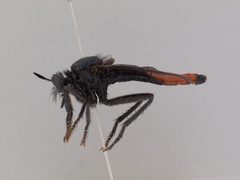
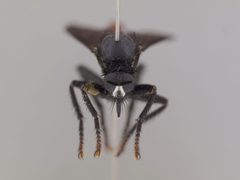
Ospriocerus aeacus is a robber fly in the Asilidae. Current taxonomic consensus treats this name as a synonym of Ospriocerus abdominalis (Say, 1824), with the latter name having priority. The species has been used frequently in literature under the O. aeacus designation, but this usage is now considered taxonomically unnecessary. As a member of the Ospriocerus, it belongs to a group of large, -mimicking robber flies associated with grassland in western North America.

Pronunciation
How to pronounce Ospriocerus aeacus: //ˌɒsprioʊˈsɪərəs ˈiːəkəs//
These audio files are automatically generated. While they are not always 100% accurate, they are a good starting point.
Identification
The is distinguished from the similar western robber fly Wyliea mydas by its black body and wings with red coloration on the (W. mydas has the abdomen wholly black and the wings red). Short immediately identify it as a robber fly rather than a mydas fly, which possess elongate clubbed antennae. The -like coloration presumably mimics spider wasps of the Pepsis and Hemipepsis (Pompilidae).
Images
Habitat
Grassland , specifically dry hilltop prairie remnants associated with the Loess Hills landform. In Canada, inhabits grasslands on the Great Plains.
Distribution
Western North America, ranging from western Canada (Alberta, Saskatchewan, Manitoba) south through the Great Plains to Texas and into Mexico. Eastern distributional limits include Nebraska, Kansas, Oklahoma, and Texas, with disjunct in critically imperiled loess hilltop prairie remnants in extreme northwest Missouri representing significant range extensions.
Behavior
are predatory. The Ospriocerus has a documented relationship with the Meloidae (blister beetles), though specific behavioral details for this are not established.
Human Relevance
Serves as an for critically imperiled prairie . Its presence in Missouri's loess hilltop prairies helped demonstrate the conservation value of these rare , which contain numerous hypsithermal relict .
Similar Taxa
- Ospriocerus abdominalisCurrently considered the valid senior synonym; O. aeacus is an unnecessary replacement name that should be discontinued per The Canadian Entomologist (2026).
- Wyliea mydasSimilar -mimicking robber fly with contrasting color pattern: wholly black with red wings versus black body and wings with red abdominal dorsum in O. aeacus/abdominalis.
- Ospriocerus latipennisSympatric congeneric inhabiting Great Plains grasslands in Canada, distinguished by morphological features detailed in Canadian species keys.
- Ospriocerus vallensisCanadian occurring in Intermontane grasslands of southern British Columbia, previously misidentified as O. abdominalis or O. aeacus in collections.
Misconceptions
The name Ospriocerus aeacus has been used frequently in literature and databases, but represents an unnecessary replacement name for O. abdominalis (Say, 1824). GBIF records this as a synonym of Stenopogon aeacus, reflecting ongoing taxonomic confusion. Canadian specimens historically identified as O. aeacus or O. abdominalis include misidentified O. vallensis.
More Details
Taxonomic Status
O. aeacus (Wiedemann, 1828) is explicitly treated as an unnecessary replacement name for O. abdominalis (Say, 1824) in recent taxonomic literature. The name has been used in sources such as Cannings (1998) for the Montane Cordillera Ecozone assessment, but current practice favors O. abdominalis.
Conservation Significance
The 2009 discovery of this (as O. abdominalis) in Missouri's loess hilltop prairies represented a new state record and significant eastern range extension. These are among Missouri's most critically imperiled natural , with only about 50 acres of original habitat remaining.