
Dioctria hyalipennis
(Fabricius, 1794)
Stripe-legged Robber Fly
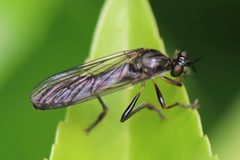
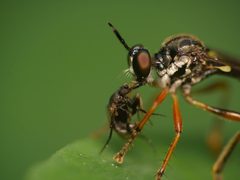
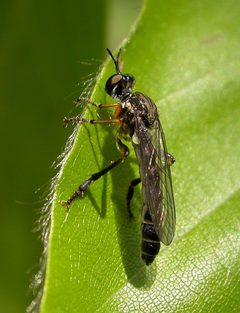
Dioctria hyalipennis is a small Holarctic robber fly (10–14 mm) in the Asilidae, characterized by distinctive black-and-yellow leg patterning and hyaline wings. are active that feed primarily on small , bees, and other insects. The occupies meadows, hedgerows, and forest edges with shrubs or conifers, and has been introduced to eastern North America from Europe.
Pronunciation
How to pronounce Dioctria hyalipennis: /diːˈɒk.tri.ə ˌhaɪ.əˈpɛn.nɪs/
These audio files are automatically generated. While they are not always 100% accurate, they are a good starting point.
Identification
Distinguished from similar by the combination of hyaline wings and yellow-and-black striped front and middle legs. Eudioctria albius males have entirely dark legs, lacking the yellow coloration. The Y-shaped with equal-length segments and the swollen first segment of the hind are additional diagnostic features. in abdominal shape is pronounced: males have narrow, wavy-constricted segments, while females are broader with orange coloration.
Images
Habitat
Meadows, hedgerows, forest edges, and field margins with large shrubs or spruce and cedar trees. Requires vegetation structure that provides perching sites for aerial hunting.
Distribution
Holarctic distribution spanning Europe and North America. Native to Europe; introduced to the Boston, Massachusetts area around 1916 from England. Documented from Belgium, Denmark, and other European localities.
Seasonality
active May to July in temperate regions.
Diet
Predatory. Feeds primarily on small and bees, including Lasioglossum and Hylaeus. Also reported to take small Diptera and pygmy grasshoppers (Tetrigidae).
Life Cycle
Complete with , larva, pupa, and stages. Specific larval and development details are not documented.
Behavior
Aerial that perches on vegetation to ambush flying prey. Oviposition not described for this .
Ecological Role
of small Hymenoptera and other insects, potentially influencing local and small insect .
Human Relevance
Introduced in North America with established in the northeastern United States. No documented economic or medical significance.
Similar Taxa
- Eudioctria albiusMales have all dark legs, lacking the yellow-and-black striped pattern characteristic of D. hyalipennis
More Details
Type Specimens
designated as Asilus hyalipennis by Fabricius, 1794 from Denmark, deposited in University of Copenhagen Zoological Museum. Multiple additional holotypes exist under synonym names in various European museums including Oxford, British Museum of Natural History, Leiden, and Paris.