
Leptogaster arborcola
Martin, 1957
Leptogaster arborcola is a of robber fly ( Asilidae) described by Martin in 1957. It belongs to the Leptogaster, a group of slender, elongate robber flies characterized by their distinctive body form and predatory habits. The specific epithet "arborcola" suggests an association with trees or arboreal . As with other members of the Leptogastrinae, it is presumed to be an aerial of small insects.
Pronunciation
How to pronounce Leptogaster arborcola: //ˌlɛptəˈɡæstər ˌɑːrbɔːrˈkɔːlə//
These audio files are automatically generated. While they are not always 100% accurate, they are a good starting point.
Identification
Distinguished from other robber flies by the combination of: extremely slender, elongate body form; long, thin legs; small relative to body length; and placement in the Leptogastrinae. Within Leptogaster, separation from requires examination of male terminalia and other subtle morphological features described in Martin's 1957 original description. The specific epithet "arborcola" may indicate preference useful for field identification where sympatric occur.
Images
Appearance
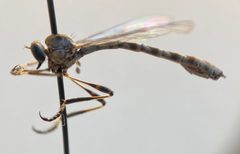
Slender, elongate body typical of the Leptogaster. Members of this genus possess an extremely elongated, cylindrical and long, thin legs adapted for perching on vegetation. The is relatively small with large . Wings are clear or lightly tinted. Specific coloration and markings for L. arborcola are not well documented in accessible literature.
Habitat
The specific epithet "arborcola" (from Latin "arbor" = tree + "cola" = dweller) indicates association with trees or arboreal vegetation. Likely inhabits wooded areas, forest edges, or with substantial tree or shrub cover. Perches on vegetation to hunt, as is typical for the .
Distribution
Original description based on material from an unspecified locality; precise type locality requires consultation of Martin (1957). Distribution data are sparse; iNaturalist records suggest occurrence in North America, but specific range boundaries remain undocumented in readily accessible sources.
Behavior
Presumed to exhibit typical leptogastrine : perching on vegetation with body oriented horizontally or at an angle, waiting to ambush small flying insect prey. The slender build and long legs are adaptations for this hunting strategy.
Ecological Role
As a predatory robber fly, functions as a of small insects. Specific prey records for this are not documented; related species in Leptogaster are known to capture small Diptera and other minute flying insects.
Human Relevance
No documented direct interactions with humans. Of interest to dipterists and students of robber fly due to its placement in the morphologically distinctive Leptogaster.
Similar Taxa
- Other Leptogaster speciesShare the extremely slender body form and long-legged appearance; require detailed morphological examination, particularly of male genitalia, for reliable identification.
- Other Asilidae (robber flies)Leptogaster are immediately distinguished by their uniquely elongate, slender build compared to the generally more robust and compact body form of most other robber fly .
More Details
Taxonomic note
The original description by Martin (1957) is the primary source for this . Accessible modern revisions of North American Leptogaster are limited, and the species is poorly represented in collections and observation databases (6 iNaturalist observations as of source date).
Etymology
The specific epithet "arborcola" is derived from Latin "arbor" (tree) and "cola" (dweller/inhabitant), directly indicating the ' association with arboreal .