
Laphria saffrana
Fabricius, 1805
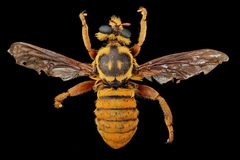
Laphria saffrana is a of robber fly in the Asilidae, Laphriinae. It belongs to a well-known for effective mimicry, though specific details about this species' appearance and are not well-documented in available sources. The species was described by Fabricius in 1805.
Pronunciation
How to pronounce Laphria saffrana: /ˈlæf.ri.ə səˈfræ.nə/
These audio files are automatically generated. While they are not always 100% accurate, they are a good starting point.
Identification
Laphria saffrana can be distinguished from other eastern North American Laphria by its coloration. It has been observed with a yellowish or saffron-colored pattern, consistent with its species epithet. As with other Laphria species, it likely exhibits dense pilosity (hairiness) and a robust body form that contributes to its -like appearance. are thick (not thin at the terminal segment), distinguishing the from the superficially similar Mallophora.
Images
Habitat
Has been observed in glade with dead pine trees in the White River Hills region of Arkansas. Likely associated with pine woodlands and forest edge environments where its larval prey (wood-boring larvae) occur.
Distribution
Eastern North America. Documented from Arkansas in the Ozark region. The Laphria is broadly distributed across North America, with multiple occurring in eastern forests.
Diet
are predatory on other insects. Larvae of all Laphriinae, including Laphria, are known to prey on wood-boring larvae (Cerambycidae and Buprestidae).
Life Cycle
Complete with , larva, pupa, and stages. Larvae develop in dead wood where they prey on wood-boring larvae. Characteristic pupal cases are often found protruding from holes in dead wood.
Behavior
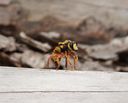
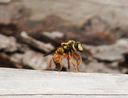
are sit-and-wait that perch on tree trunks, logs, or other surfaces to ambush prey. Like other robber flies, they are strong fliers and can be wary of approach. One observer noted difficulty photographing the due to its alertness and tendency to fly away when approached.
Ecological Role
As a , help regulate of other insects. Larvae function as specialized predators of wood-boring beetles, potentially influencing forest insect dynamics and nutrient cycling in dead wood .
Similar Taxa
- Laphria thoracicaAnother common eastern North American mimic in the same ; distinguished by thoracic coloration patterns
- Mallophora speciesAlso effective mimics, but have thin terminal antennal segments and denser hairiness; not closely related despite convergent appearance
More Details
Taxonomic note
The specific epithet 'saffrana' refers to a saffron or yellowish coloration, likely describing some aspect of the ' appearance.
Research gap
Despite being a described since 1805, detailed natural history information for L. saffrana specifically is sparse in the accessible literature. Much of what is inferred about its comes from studies of and the Laphriinae as a whole.