
Laphria thoracica
Fabricius, 1805
Eastern Yellow-backed Laphria
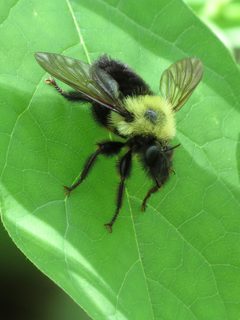
Laphria thoracica is a of robber fly in the Asilidae, commonly known as the Eastern Yellow-backed Laphria. The species is a notable mimic, using its resemblance to stinging bees to avoid while ambushing prey. It belongs to a recognized for highly effective mimicry of bees and .
Pronunciation
How to pronounce Laphria thoracica: /ləˈfɹaɪə θoʊˈɹæsɪkə/
These audio files are automatically generated. While they are not always 100% accurate, they are a good starting point.
Identification
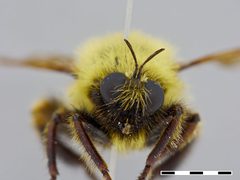
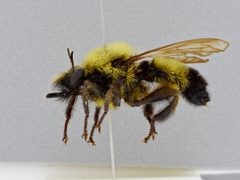
Laphria thoracica can be distinguished from other Laphria by its yellow thoracic markings, which give rise to its . The species exhibits effective mimicry, with a hairy body and coloration resembling bumble bees or carpenter bees. It has thick (not thin terminal segments like the related Mallophora). Differentiation from other bumble bee mimics such as Mallophora requires examination of antennae structure: Laphria has uniformly thick antennae, while Mallophora has a thin terminal segment.
Images
Distribution
Eastern North America. Distribution records include Vermont and other parts of the United States.
Life Cycle
Larvae develop in rotting wood, where they prey on wood-boring larvae. This habit is shared with other Laphria .
Behavior
are ambush that perch on vegetation or logs to spot prey. They capture small flying insects, particularly small beetles, in mid-air and return to a perch to feed. The exhibits effective mimicry, which likely serves both to deter predators and to deceive prey into allowing close approach.
Ecological Role
of other insects, including wood-boring larvae in the larval stage and various small flying insects as . Contributes to regulation of beetle in forest .
Human Relevance
May be encountered by naturalists and photographers; its mimicry can lead to misidentification as a . The is a subject of interest for studies of mimicry in insects.
Similar Taxa
- Mallophora speciesAlso mimics, but distinguished by thin terminal antennal segment versus thick in Laphria
- Bombus species (bumble bees)Visual mimic; Laphria thoracica is a fly (single pair of wings, , large ) while bumble bees are Hymenoptera (two pairs of wings, elbowed , less prominent eyes)
More Details
Mimicry effectiveness
Laphria thoracica is considered among the most realistic mimics in North America, with and appearance sufficiently convincing to fool both and prey, as well as human observers.