
Laphria lata
Macquart, 1850
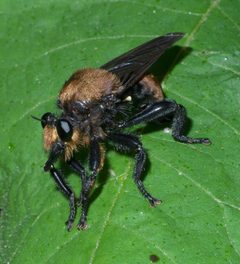
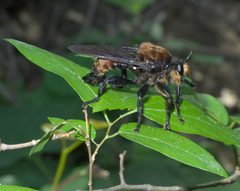
Laphria lata is a of robber fly in the Asilidae. Robber flies in this are notable for their effective mimicry of bumble bees, with hairy bodies and coloration that closely resembles their hymenopteran models. The species has been documented as a of (Popillia japonica), using its piercing to subdue prey. As with other Laphria species, it likely exhibits the characteristic sit-and-wait hunting typical of the genus.
Pronunciation
How to pronounce Laphria lata: /ˈlæf.ri.ə ˈleɪ.tə/
These audio files are automatically generated. While they are not always 100% accurate, they are a good starting point.
Identification
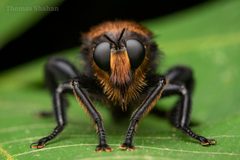
Distinguished from the similar -mimicking Mallophora by its thick (Mallophora has a thin terminal antennal segment). Laphria lata is hairier than most other robber fly genera. The combination of large size, dense hair, and bumble bee coloration separates it from non-mimetic robber flies. Accurate -level identification within Laphria typically requires examination of genitalia or other subtle morphological features.
Images
Appearance
Large, robust fly with dense hair covering the body. are thick and relatively short, lacking the thin terminal segment seen in the related -mimicking Mallophora. Body form and coloration closely mimic bumble bees, with banded patterning of black and yellow or orange hairs.
Distribution
Eastern North America; documented in the United States
Diet
Predatory; has been observed preying on (Popillia japonica). As with other robber flies, likely captures a variety of flying insects including bees, , and beetles.
Behavior
Exhibits sit-and-wait predatory typical of robber flies, perching on vegetation to ambush passing prey. is more direct and purposeful than that of actual bumble bees, which tend to have a more meandering, 'bumbling' flight pattern. This behavioral difference can aid in detection of the mimic.
Ecological Role
Apex aerial in its ; contributes to regulation of insect including agricultural pests such as . Its mimicry of bumble bees may provide protection from predators that avoid stinging hymenopterans.
Human Relevance
Considered a beneficial insect in gardens and agricultural settings due to on , a significant pest. Conservation of natural landscapes supports of this and other predatory insects that provide services.
Similar Taxa
- MallophoraAlso mimics bumble bees, but distinguished by thin terminal segment on (Laphria has uniformly thick antennae) and generally hairier appearance
- Bombus (bumble bees)True bumble bees have two pairs of wings (flies have one), longer , and different ; Laphria has only one pair of wings plus , short antennae, and more direct flight
More Details
Taxonomic note
Authorship sometimes cited as Macquart, 1846 in some sources, though 1850 is the accepted date in Catalogue of Life.