
Laphria apila
(Bromley, 1951)
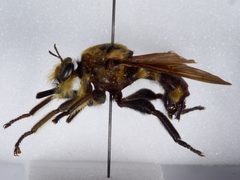
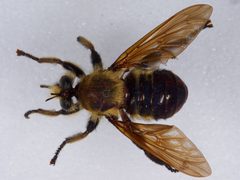
Laphria apila is a of robber fly in the Asilidae. It belongs to the Laphria, a group known for effective mimicry. The species was described by Bromley in 1951. Like other robber flies, it is a predatory insect that captures prey in .
Pronunciation
How to pronounce Laphria apila: /ˈlæfriə əˈpiːlə/
These audio files are automatically generated. While they are not always 100% accurate, they are a good starting point.
Identification
in the Laphria are recognized by their thick , distinguishing them from the related -mimicking genus Mallophora, which has thin terminal antennal segments. Specific identification features for L. apila are not documented in available sources.
Images
Distribution
The has been recorded from 32 observations on iNaturalist, though specific geographic range details are not well-documented in available sources.
Diet
As a member of the Asilidae , it is predatory on other insects, though specific prey records for L. apila are not documented.
Ecological Role
As a predatory robber fly, it likely functions as an aerial of other insects within its .
Similar Taxa
- MallophoraBoth are effective mimics, but Mallophora are hairier and have thin terminal antennal segments, whereas Laphria has thick .
- Laphria species complexOther Laphria share the -mimicking appearance and thick ; species-level identification within the requires detailed examination.
More Details
Taxonomic note
The was originally described by S.W. Bromley in 1951. The name Laphria derives from Greek, though the specific epithet 'apila' etymology is not documented in available sources.