
Andrenosoma fulvicaudum
(Say, 1823)
Northern Chiselmouth
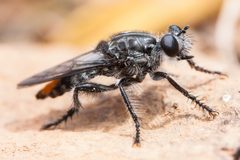
Andrenosoma fulvicaudum is a robber fly ( Asilidae) in the Laphriinae, distributed across most of North America. measure 15–20 mm and are characterized by distinctive reddish-brown terminal abdominal segments contrasting with blue-black segments. The is associated with dry, sandy and dead wood, where adults perch on sunlit tree trunks and logs to hunt small insects. Larvae develop as of wood-boring larvae.
Pronunciation
How to pronounce Andrenosoma fulvicaudum: //ænˌdrɛnoʊˈsoʊmə fʊlˈvaɪkaʊdəm//
These audio files are automatically generated. While they are not always 100% accurate, they are a good starting point.
Identification
Distinguished from other eastern North American robber flies by the combination of: reddish-brown terminal abdominal segments ( 3–4 segments) contrasting with dark segments; black mystax with stout bristles; white-haired and ; dark wings with brownish-smudged ; and yellow tarsal claws. The only of Andrenosoma in eastern North America; western and Texas species are .
Images
Habitat
Dry, sandy locations with trees; specifically acidic sandstone barrens, pine-oak forests, and recently burned forests. rest on logs, stumps, and tree trunks (especially dead pines and oaks) exposed to bright sunlight.
Distribution
Widespread across most of North America. Eastern North America: only of Andrenosoma present. Western : additional species restricted to Texas (4 species) and western United States (1 species). reaches greatest diversity in the Neotropics.
Seasonality
active in July and August. Attracted to recently burned forests.
Diet
prey on small hymenopterans (bees and ) and have been observed feeding on wood-boring beetles (Buprestidae, Cerambycidae) and true bugs (Miridae).
Host Associations
- Chrysobothris femorata - preyLarvae collected in of this buprestid under oak log bark
- Miridae - prey observed feeding on mirid bug
Life Cycle
Complete . Larvae and pupae develop under bark of dead wood, particularly oak logs, in association with wood-boring larvae. occurs in characteristic pupal cases that may protrude from holes in dead wood. Specific developmental duration unknown.
Behavior
are sit-and-wait , perching motionless on sunlit tree trunks and logs to ambush passing prey. Attracted to smoke and recently burned forests, likely due to increased availability of larval food resources (wood-boring beetles in fire-killed trees).
Ecological Role
at two : control of small hymenopterans and other insects; larvae prey on wood-boring larvae (Buprestidae, Cerambycidae), potentially regulating populations of these forest pests.
Human Relevance
Of minor direct economic importance. potential through on wood-boring beetles. Subject of entomological interest due to association with fire and wood-boring .
Similar Taxa
- Laphria spp.Also in Laphriinae with similar robust build and -mimic coloration in some ; distinguished by different abdominal color patterns and lack of reddish terminal segments.
- Other Andrenosoma speciesFour restricted to Texas and one to western U.S.; distributions prevent confusion with A. fulvicaudum in eastern North America.
More Details
Taxonomic history
Originally described as Laphria fulvicauda by Thomas Say in 1823 based on a specimen from Missouri; the has been lost.
Fire ecology association
Documented attraction to recently burned forests, where fire-killed trees provide fresh substrate for wood-boring larvae—the prey of A. fulvicaudum larvae.
Larval development
Laphriinae are unique among Asilidae in that all have larvae that prey on wood-boring larvae; this is the only with this specialized larval .
Sources and further reading
- BugGuide
- Wikipedia
- GBIF taxonomy match
- iNaturalist taxon
- NCBI Taxonomy
- Catalogue of Life
- T.G.I.Flyday – Andrenosoma fulvicaudum | Beetles In The Bush
- Ozark Landscapes – White River in northern Arkansas | Beetles In The Bush
- T.G.I.Flyday | Beetles In The Bush
- Arkansas | Beetles In The Bush | Page 3
- October | 2011 | Beetles In The Bush | Page 2
- [No taxon] | Beetles In The Bush | Page 10