
Andrenosoma
Rondani, 1856
Chiselmouths
Species Guides
6- Andrenosoma corallium
- Andrenosoma cruentum(Mangrove Chiselmouth)
- Andrenosoma fulvicaudum(Northern Chiselmouth)
- Andrenosoma hesperium(Golden-horned Chiselmouth)
- Andrenosoma igneum(Fiery Chiselmouth)
- Andrenosoma xanthocnemum(Texas Chiselmouth)
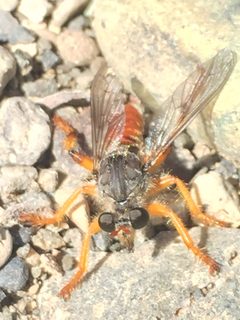
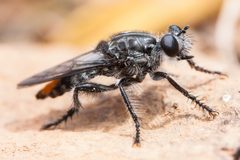
Andrenosoma is a of robber flies ( Asilidae) in the Laphriinae, containing at least 70 described . The genus is distributed across North America, Europe, and the Neotropics, with greatest diversity in the Neotropical region. Species are associated with dead wood , where larvae prey on wood-boring larvae. are predatory and typically perch on sun-exposed surfaces such as tree trunks, logs, and stumps.
Pronunciation
How to pronounce Andrenosoma: //ˌændrɛnəˈsoʊmə//
These audio files are automatically generated. While they are not always 100% accurate, they are a good starting point.
Identification
Members of Andrenosoma can be distinguished from other Laphriinae by the combination of: a chisel-like (the source of the 'Chiselmouths'); body typically covered with dense pile giving a -like appearance; and characteristic abdominal color patterns, including reddish posteriodorsal markings in some . The is distinguished from the similar-appearing Laphria by subtle differences in wing venation and genitalic structure, requiring examination of these features for definitive identification.
Images
Habitat
in this are strongly associated with dead wood , particularly standing dead pines and other conifers. frequent dry, sandy locations and are attracted to recently burned forests. They rest on sun-exposed surfaces including logs, stumps, and tree trunks. In North America, they occur in acidic sandstone barrens, pine-oak forests, and glade systems.
Distribution
The has a broad distribution spanning North America, Europe (including Spain), and the Neotropics. In North America, one (A. fulvicaudum) occurs across most of the continent east of the Rocky Mountains, four additional species are restricted to Texas, and one occurs in the western United States. The genus reaches its greatest diversity in the Neotropics. In Europe, at least five species have been recorded from Spain.
Diet
are active that capture flying insects. A. fulvicaudum has been observed preying on small hymenopterans and mirid bugs. Larvae are specialized predators of wood-boring larvae, particularly in the Buprestidae and Cerambycidae.
Host Associations
- Buprestidae - preylarvae prey on wood-boring buprestid larvae
- Cerambycidae - preylarvae prey on wood-boring cerambycid larvae
- Pinaceae - standing dead pines provide for prey and larval development
Life Cycle
Larvae develop in dead wood, feeding on wood-boring larvae. occurs within the wood, with characteristic pupal cases often found protruding from holes. emerge from these pupal cases.
Behavior
are sit-and-wait that perch on sun-exposed surfaces to ambush prey. They are wary and can be difficult to approach closely. The shows affinity for recently burned forests, likely due to increased availability of dead wood and wood-boring larvae.
Ecological Role
Andrenosoma serves as a significant of wood-boring beetles, potentially regulating of these insects in forest . The also functions as a aerial predator in the it occupies.
Human Relevance
may be encountered by entomologists and naturalists in forested . The distinctive appearance of makes them notable subjects for macrophotography. No significant economic impacts are documented.
Similar Taxa
- LaphriaSimilar -mimicking appearance and placement; distinguished by wing venation and genitalic differences
- MicrostylumBoth are large, charismatic robber flies in Laphriinae; Microstylum are generally larger with different coloration and lack the chisel-like
More Details
Collection notes
are sometimes reared from dead wood batches set out for wood-boring beetles, with pupal cases preserved alongside specimens for potential taxonomic study.
Taxonomic history
The has undergone recent taxonomic revision in Europe, with new described from Spain (A. biacuminatum, 2017).
Sources and further reading
- BugGuide
- Wikipedia
- GBIF taxonomy match
- iNaturalist taxon
- NCBI Taxonomy
- Catalogue of Life
- T.G.I.Flyday – Andrenosoma fulvicaudum | Beetles In The Bush
- Ozark Landscapes – White River in northern Arkansas | Beetles In The Bush
- T.G.I.Flyday | Beetles In The Bush
- Arkansas | Beetles In The Bush | Page 3
- October | 2011 | Beetles In The Bush | Page 2
- [No taxon] | Beetles In The Bush | Page 10
- Taxonomic review of the species of Andrenosoma (Diptera: Asilidae) in Spain and description of a new species